
people
-
Giulia Galli wins Joseph O. Hirschfelder Prize in Theoretical Chemistry
From the University of Chicago Giulia Galli has been named the 2024-2025 Joseph O. Hirschfelder Awardee. The University of Wisconsin-Madison’s Theoretical Chemistry Institute awards the yearly prize for exceptional work in the field of theoretical chemistry. Four Nobel Prize recipients are among the Hirschfelder Prize honorees. Read More
-
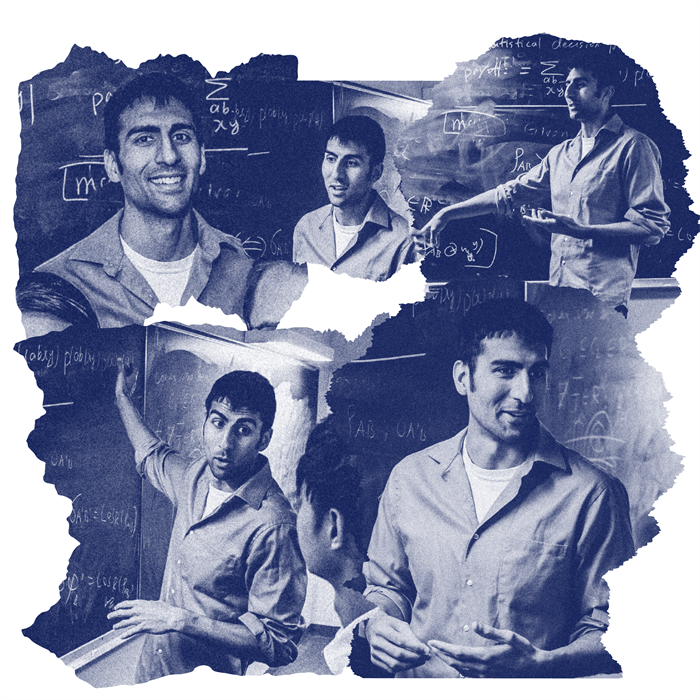
'Get entangled' with Eric Chitambar
At the University of Illinois Urbana-Champaign, theorist Eric Chitambar studies quantum communication. He is passionate about teaching and appreciates the strong collaborative spirit at UIUC, where his experimentalist colleagues help realize his group's ideas on hardware. Read More
-

Meet Edward Schmitt, facilities engineer
Former Marine Corps electronics technician Edward Schmitt keeps the Argonne Quantum Foundry running while advocating for veterans. Read More
-
Choy will use an NSF CAREER award to create quantum-based navigation systems
From the University of Wisconsin–Madison: Q-NEXT collaborator Jennifer Choy of the University of Wisconsin–Madison is using her NSF CAREER award to develop quantum sensors that could supplement or supplant GPS. Read More
-

Chloe Washabaugh creates designer molecules for the quantum future
Q-NEXT collaborator and UChicago grad student Chloe Washabaugh creates high-performance qubits from designer molecules. Not only is she expanding the applications of quantum devices, but she’s also working to attract a diverse audience to quantum. Read More
-
Jelena Vučković appointed at MPQ as new external scientific member
From the Max Planck Institute for Quantum Optics: Q-NEXT collaborator and Stanford University Professor Jelena Vučković has been connected to the Max Planck Institute of Quantum Optics for years. She has now been appointed an external scientific member of the institute. Read More
-
Ask an expert: Choy discusses qubits, atomic clocks, computing and more
From the University of Wisconsin–Madison: In this Q&A, Q-NEXT collaborator and University of Wisconsin–Madison Assistant Professor Jennifer Choy discusses quantum sensing, one of several growing research fields that use quantum mechanics for applications ranging from creating nanoscale optical sensors to the supercomputers of the future. Read More
-
Pushing the quantum frontier for finance: JPMorgan Chase’s Marco Pistoia
An institutional partner of the Q-NEXT quantum research center, JPMorgan Chase is advancing quantum technologies for the financial sector while collaborating with other organizations to push the quantum frontier for all. Read More
-
Victor Brar earns NSF CAREER award
From the University of Wisconsin–Madison: Q-NEXT collaborator and UWMadison Associate Professor Victor Brar has earned an NSF CAREER award. CAREER awards are NSF’s most prestigious awards, supporting early-career faculty who have the potential to serve as academic role models in research and education and to lead advances in the mission of their department or organization. Read More
-
The science of light
From Stanford University: Jelena Vuckovic and Jennifer Dionne are featured for their work on photonics research. Read More
In the News
See all In the News-
Uncovering the hidden disorder in silicon quantum computers
From the U.S. Department of Energy: Q-NEXT researchers map the variation in materials to the atom level to scale up silicon qubits Read More
-
Neutral atom computers: the physics of Rydberg quantum gates | Mark Saffman
From 632nm: Mark Saffman, professor at the University of Wisconsin–Madison and chief scientist at Infleqtion, discusses the physics of optical tweezers and Rydberg gates, how neutral atoms perform quantum logic and create entanglement, and why this platform offers advantages in connectivity and scalability. Read More
-
Prof. Giulia Galli appointed CNRS Fellow-Ambassador
From the University of Chicago: With the appointment, Galli joins a prestigious cohort of leading figures from the world’s scientific community. Read More
-
Tuning into quantum sounds
From Caltech: Researchers at Caltech and Stanford University, including Stanford's Amir Safavi-Naeini, create tiny vibrating devices that can naturally display quantum behavior without needing an external quantum circuit. By harnessing microscopic defects already present in the material, the team achieved single-phonon nonlinear effects that could enable simpler quantum sensors capable of detecting and studying individual molecules with extraordinary sensitivity. Read More
-
Illinois touts growing quantum workforce as state shows industry leadership
From NPR Illinois: Q-NEXT Workforce Development Lead Emily Easton discusses the growing quantum education and workforce ecosystem in Illinois. Read More