Science Resources

World-class research facilities

Q-NEXT draws on national science resources and facilities to build, measure and test new materials for quantum systems and to simulate and model quantum information environments. As a national research center with partners across the national labs, academia and industry, Q-NEXT facilitates access to these facilities, accelerating research.
Argonne Quantum Foundry

Argonne Quantum Foundry

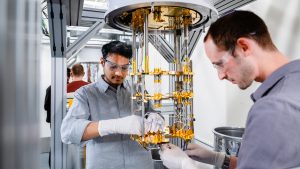
Located at Argonne National Laboratory, the Argonne Quantum Foundry is a 6,000-square-foot facility focused on developing scalable semiconductor quantum systems. The foundry is home to a quantum computing test bed, tools for growing qubits and their host materials, environment-controlled annealing furnaces, and materials transfer and flip-chip bonders for integrating qubits with other devices.​

Learn more

SLAC Superconducting Quantum Foundry

SLAC Superconducting Quantum Foundry

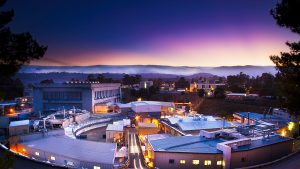
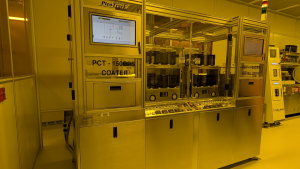
The SLAC Superconducting Quantum Foundry, located at SLAC National Accelerator Laboratory, is a 5,500-square-foot cleanroom on the ground floor of the lab’s three-story Arrillaga Science Center. The facility houses state-of-the-art tools and equipment for building, testing and measuring superconducting materials for quantum devices and systems. Foundry researchers help establish methods and standards to improve superconducting processes and provide high-performance quantum devices for Q-NEXT and other DOE missions.

Learn more

Advanced Photon Source

Advanced Photon Source

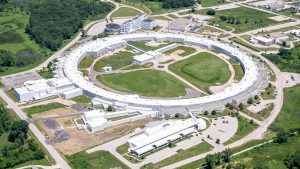
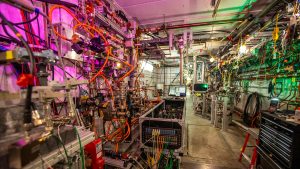
The Advanced Photon Source at Argonne National Laboratory provides ultrabright, high-energy X-ray beams to more than 5,000 scientists around the world. Researchers use the APS to provide detailed maps of a quantum material’s structure, track atomic movements and dynamics in quantum systems, and observe how a material’s structure changes when exposed to different physical changes. These characterization studies help scientists design better and higher-performing qubit materials.

Learn more

Argonne Leadership Computing Facility

Argonne Leadership Computing Facility

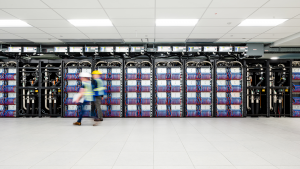
The Argonne Leadership Computing Facility, home to some of the most advanced computers available and used to solve some of the toughest challenges in science and engineering. ALCF is home to the Aurora exascale supercomputer, one of the three fastest supercomputers in the nation, capable of performing quintillions of calculations per second. Scientists use ALCF to simulate quantum algorithms, simulate and test quantum error correction in quantum systems, help design quantum hardware and materials and test hybrid quantum-classical computers.

Learn more

Center for Nanoscale Materials

Center for Nanoscale Materials

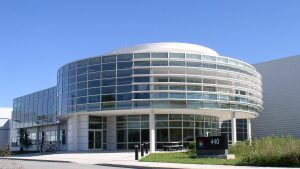
Argonne’s Center for Nanoscale Materials provides scientists from around the world with world-class expertise and instrumentation for multidisciplinary nanoscience and nanotechnology research. At CNM, scientists design, measure and test materials for applications in communication and sensing, advancing fields such as medicine, navigation, logistics, finance and discovery science.

Learn more

Linac Coherent Light Source II

Linac Coherent Light Source II

SLAC National Accelerator Laboratory’s Linac Coherent Light Source II is a free-electron laser that allows scientists to view process dynamics at the atomic scale and at ultrafast shutter speeds. LCLS-II provides scientists with a view into the behavior of quantum materials and how they respond to changes in surrounding electric and magnetic fields.

Learn more

Stanford Synchrotron Radiation Lightsource

Stanford Synchrotron Radiation Lightsource

The bright X-rays from the Stanford Synchrotron Radiation Lightsource enable scientists to delve into the intriguing characteristics of quantum materials and deploy cutting-edge experimental techniques at its soft X-ray beamlines. Combined with sophisticated materials synthesis capabilities and extreme sample environments, the deployment of these techniques has led to a vibrant and highly productive quantum materials user research program.

Learn more

Chicago Quantum Network

Chicago Quantum Network

The Chicago Quantum Network is a 124-mile network that connects nodes in Chicagoland, with a planned node in Urbana-Champaign, Illinois. One of the largest quantum networks in the country, the Chicago Quantum Network provides a test bed for scientists to test protocols, practices and hardware for hackerproof, metropolitan-scale quantum communication.

Learn more

Low-Energy Accelerator Facility

Low-Energy Accelerator Facility

The Low‑Energy Accelerator Facility (LEAF) at Argonne is a linear accelerator that provides high-powered electron beams to produce radioisotopes for medical imaging, national security, industrial applications, and materials research. Scientists embed isotopes produced by LEAF in solid-state materials, creating qubits that can be used in applications such as medical imaging and nanomaterials research.

Learn more

MeV-UED

MeV-UED

SLAC National Accelerator Laboratory’s Mega-electron-volt Ultrafast Electron Diffraction instrument, or MeV-UED, acts like an “electron camera,” giving scientists a way to control and analyze the dynamics of materials at the molecular scale using the technique of electron diffraction. This gives researchers insight into how they can improve the performance of materials that serve as the basis of quantum technologies.

Learn more

ATLAS

ATLAS

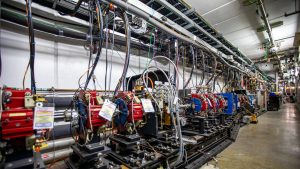
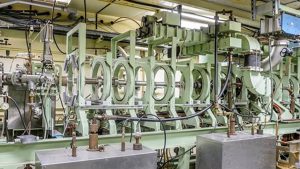
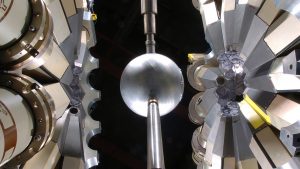
The Argonne Tandem Linac Accelerator System, or ATLAS, is a powerful superconducting linear accelerator capable of producing ion beams from any element or isotope. This ability has the potential to make ATLAS an invaluable tool for supplying ions to be used as qubits, giving scientists remarkable flexibility in creating novel quantum systems within a variety of host materials. ATLAS also enables researchers to explore the quantum properties of nuclei and how they can be harnessed for next-generation quantum communication and sensing devices.

Learn more

Next Linear Collider Test Area

Next Linear Collider Test Area

A SLAC National Accelerator Laboratory’s Next Linear Collider Test Area (NLCTA), a high precision electron beam is used to create defects in materials. These defects can act as color-centers, or qubits that are controlled with light, electric fields and magnetic fields.

Learn more

NMR Spectroscopy Lab

NMR Spectroscopy Lab

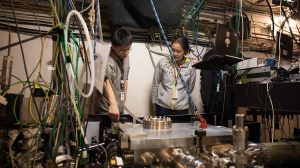
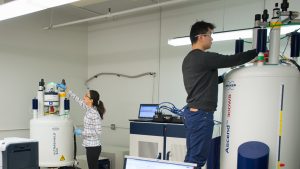
At Argonne’s Nuclear Magnetic Resonance Spectroscopy Laboratory, scientists probe materials’ atomic structure and dynamics as well as their surface and interface chemistries. The lab’s cutting-edge tools create a unique platform for future demonstrations of quantum-advantaged magnetic detectors and to investigate the atomic- and molecular-scale behavior of materials for potential use in quantum devices and systems.

Learn more