 Extended spin relaxation times of optically addressed vanadium defects in silicon carbide at telecommunication frequencies
Physical Review Applied (2024)
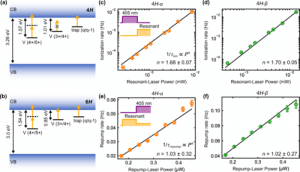
In this study, a research team uses vanadium in silicon carbide to establish a spin-photon interface with potential application in fiber-optic communication.
The researchers were able to efficiently manipulate and measure the spin states of these defects using only light, without requiring additional control mechanisms. The spin states of the vanadium defects also showed a massive improvement in their relaxation times — which can limit how long they can retain information — when the temperature was lowered from 2 Kelvin to 100 millikelvin. The improvement ranged from 57 milliseconds to nearly 28 seconds across different sites, a 10,000-fold increase.
The results show that vanadium in silicon carbide is a promising candidate for building scalable quantum networks.
The paper’s authors are Jonghoon Ahn, Christina Wicker, Nolan Bitner, Michael T. Solomon, Benedikt Tissot, Guido Burkard, Alan Dibos, Jiefei Zhang, F. Joseph Heremans and David Awschalom, conducting work at Argonne National Laboratory, the University of Chicago and the University of Konstanz.