
Solving hard optimization problems with QAOA

Spin-boson mapping of the Quantum Approximate Optimization Algorithm
Physical Review Letters (2026)


The Quantum Approximate Optimization Algorithm (QAOA) is a quantum computing method designed to solve hard optimization problems. In general, making the algorithm deeper — adding more rounds — improves its performance. But studying very deep versions has been difficult because the calculations needed to predict their behavior become overwhelmingly expensive.

In this work, researchers found a new way to study deep QAOA circuits for a well-known optimization problem called the Sherrington–Kirkpatrick model, which describes a complex system of interacting spins.

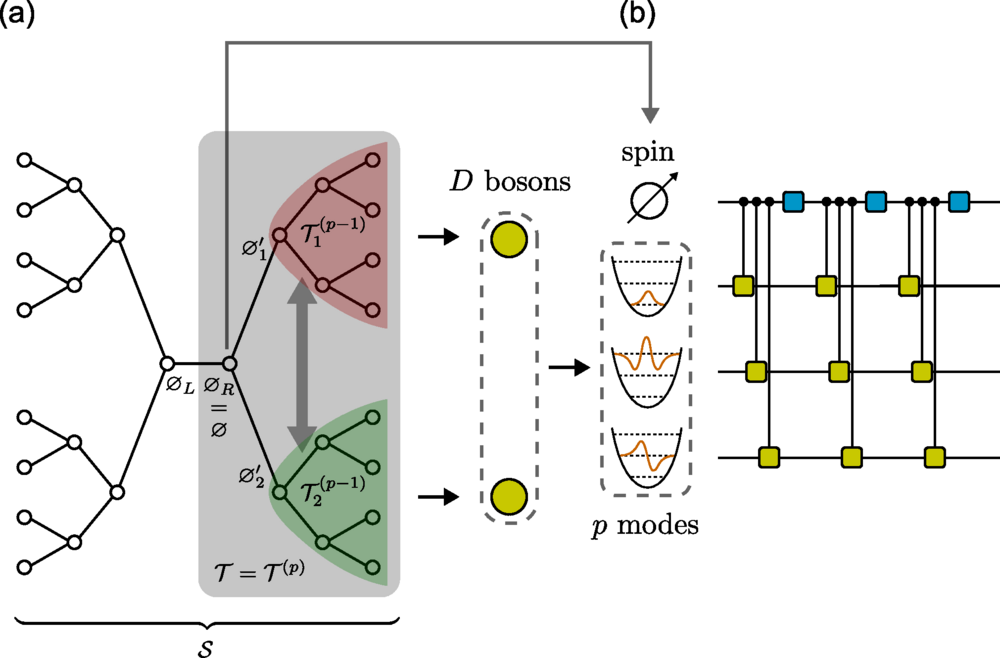
They showed that, for very large systems, the quantum behavior can be effectively described by a model of a single spin interacting with several vibration-like quantum modes. This shortcut made simulations much more efficient, allowing the team to study much deeper QAOA circuits than before — up to depth 160 rather than about 20.

Their results suggest that deeper QAOA circuits can get very close to the best possible answer, providing a new way to understand and improve quantum optimization algorithms.

The paper’s authors are Sami Boulebnane, Abid Khan, Henry Minzhao Liu, Jeffrey Larson, Dylan Herman, Ruslan Shaydulin and Marco Pistoia, who conducted their work at Argonne National Laboratory and JPMorgan Chase.

News and features

See all news and features
  • David Awschalom wins global Breakthrough of the Year award

    David Awschalom, Q-NEXT Chief Science Officer and the Liew Family Professor of Quantum Engineering and Physics at the University of Chicago, received the prestigious Falling Walls Science Breakthrough of the Year in Physical Sciences for a pioneering body of work that broke the wall between quantum technology, molecules, and proteins. Read More

  • Helium lifts new quantum computing concept

    A team led by Jacob Covey, who is part of Q-NEXT and is an Associate Professor at the University of Chicago, laid out a new concept that could turn helium’s light weight into the next generation of quantum computers. The design relies on helium-3, an isotope with different quantum properties than the helium-4 used to cool MRI machines and fill party balloons. Once built, the computer could use high-powered lasers as “optical tweezers” to capture and control individual atoms of helium. Read More

  • Researchers make materials that support quantum technology

    Researchers from the University of Illinois Urbana-Champaign who are part of Q-NEXT are engineering material systems that support quantum technology. Chris Anderson and his team are developing materials for quantum transduction — the conversion of quantum information from one form to another. Elizabeth Goldschmidt, Daniel Shoemaker, and colleagues are developing quantum memory technology that stores quantum information for extended periods of time. Read More

  • Q-NEXT-developed open-source software receives 2026 R&D 100 award

    SeQUeNCe, a free, open-source software developed by Argonne scientists with Q-NEXT support, is one of seven Argonne projects that received a 2026 R&D 100 Award. The SeQUeNCe software lets researchers test how quantum networks might work before building them. Read More

  • Researchers generate spontaneous magnons that synchronize with external signals

    Researchers at Argonne and the University of Illinois Urbana-Champaign demonstrate a method for generating stable ripples in magnetic materials called magnons. The work opens avenues for information processing in microelectronics and quantum devices. Read More