Engineering diamond interfaces free of dark spins
Physical Review Applied (2026)
Nitrogen-vacancy (NV) centers in diamond are powerful quantum sensors that can detect extremely small magnetic signals, even from individual electron spins. However, unwanted electron spins naturally found on the diamond surface create background noise that can interfere with measurements and make it harder to detect the signals researchers care about.
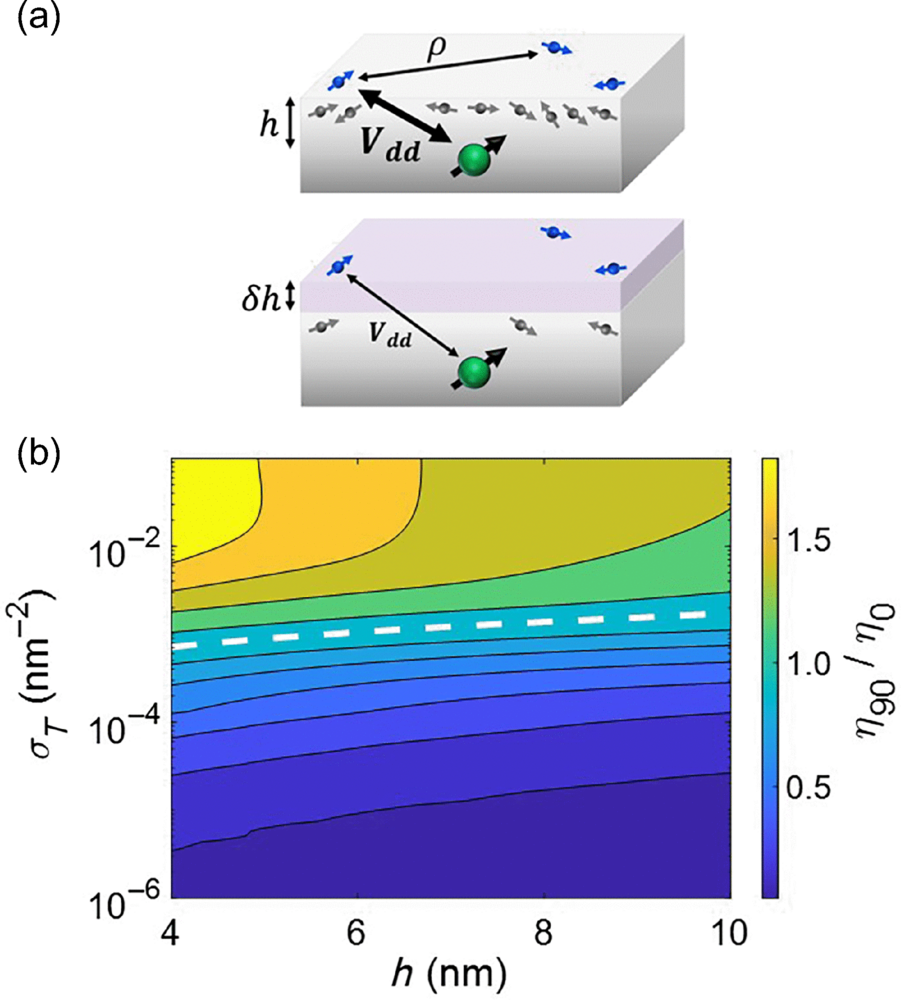
In a recent study, researchers developed a way to reduce that noise by coating the diamond surface with a very thin layer of titanium oxide. The coating dramatically lowered the number of unwanted surface spins by an order of magnitude and doubled the coherence time of NV centers located near the surface, allowing them to function as better quantum sensors. The team also developed a model explaining how these surface spins affect sensor performance. The results could help improve not only diamond-based sensors but also other quantum technologies, including solid-state and superconducting qubits.
The paper’s authors are Xiaofe Yu, Evan J. Villafranca, Stella Wang, Jessica C. Jones, Mouzhe Xie, Jonah Nagura, Ignacio Chi-Durán, Nazar Delegan, Alex B. F. Martinson, Michael Flatté, Denis R. Candido, Giulia Galli and Peter C. Maurer, who conducted their work at the University of Chicago, Argonne National Laboratory, Arizona State University, University of Illinois Urbana-Champain, Eindhoven University of Technology, University of Iowa and CZ Biohub Chicago.