 State preparation in quantum algorithms for fragment-based quantum chemistry
Journal of Chemical Theory and Computation (2024)
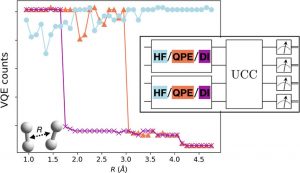
Preparing quantum states accurately is vital for quantum algorithms to compete with classical algorithms. The LAS–UCC algorithm is a quantum-classical technique that uses a fragment-based classical wave function to prepare an initial state efficiently and a quantum computer to entangle the fragments.
In this paper, researchers compared two methods — quantum phase estimation (QPE) and direct initialization (DI) — for preparing each fragment’s state. They tested the methods on three systems, from simple to complex.
They found that DI requires fewer resources for smaller fragments, while QPE is more efficient for larger fragments. Their results suggest that system fragmentation is beneficial for state preparation in subsequent quantum chemical calculations, with potential applications in realistic chemical problems.
The study’s authors are Ruhee D’Cunha, Matthew Otten, Matthew Hermes, Laura Gagliardi and Stephen K. Gray, who conducted their research at the University of Chicago, Argonne National Laboratory and HRL Laboratories.