 Exploring nonmultiplicativity in the geometric measure of entanglement

Phys Rev A (2025)
The geometric measure of entanglement is a way of quantifying how entangled a quantum state is. It works by comparing a quantum state to its nearest nonentangled state and measuring how similar they are. Sometimes, when you look at combinations of states, the nearest nonentangled state still contains some entanglement across parts of the system — a surprising effect called nonmultiplicativity.
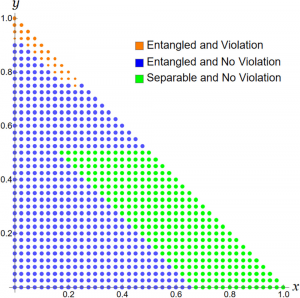
In this paper, researchers studied nonmultiplicativity in two special families of quantum states. They found that it appears around a particular type of state called the antisymmetric projector
They used advanced numerical tools to examine this in detail for small systems. They also tested a simpler version of the measure, where they restrict attention to states with only real numbers, and find that even this restricted version can show the same unexpected effect.
The paper’s authors are Daniel Dilley, Jerry Chang, Jeffrey Larson and Eric Chitambar, who conducted the research at Argonne National Laboratory and the University of Illinois Urbana-Champaign.