
Modular processors and mitigating error

Mitigating cosmic-ray-like correlated events with a modular quantum processor

Physical Applied Review (2025)
 
Quantum computers built from superconducting qubits are growing and now can test small versions of error-correction codes — methods that help protect quantum information from noise. However, systemwide failures can be caused by cosmic rays hitting the chip.

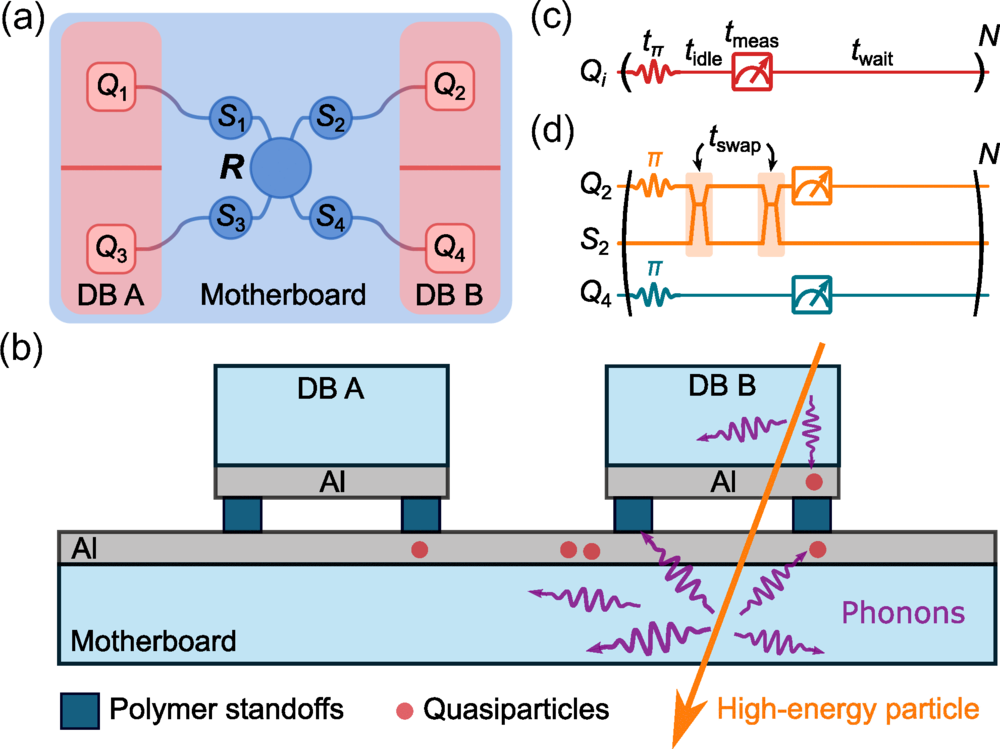
In this paper, researchers tested whether breaking a quantum computer into smaller, connected modules could limit the spread of these errors. Using a setup with one main board and two smaller modules, each containing two qubits, they found that when a disturbance hit one module, the qubits inside it were strongly affected together, but qubits on different modules were mostly unaffected. This shows that modular designs could help contain cosmic-ray-induced errors, making quantum processors more stable and easier to protect with specialized error-correction strategies.

The paper’s authors are Xuntao Wu, Yash Joshi, Hoaxiong Yan, Gustav Andersson, Alexander Anferov, Christopher Conner, Bayan Karimi, Amber King, Shiheng Li, Howard Malc, Jacob Miller, Harsh Mishra, Hong Qiao, Minseok Ryu, Siyuan King, Jian Shi and Andrew Cleland, who conducted their work at the University of Chicago, the Rensselaer Polytechnic Institute and Argonne National Laboratory.

News and features

See all news and features
  • David Awschalom wins global Breakthrough of the Year award

    David Awschalom, Q-NEXT Chief Science Officer and the Liew Family Professor of Quantum Engineering and Physics at the University of Chicago, received the prestigious Falling Walls Science Breakthrough of the Year in Physical Sciences for a pioneering body of work that broke the wall between quantum technology, molecules, and proteins. Read More

  • Helium lifts new quantum computing concept

    A team led by Jacob Covey, who is part of Q-NEXT and is an Associate Professor at the University of Chicago, laid out a new concept that could turn helium’s light weight into the next generation of quantum computers. The design relies on helium-3, an isotope with different quantum properties than the helium-4 used to cool MRI machines and fill party balloons. Once built, the computer could use high-powered lasers as “optical tweezers” to capture and control individual atoms of helium. Read More

  • Researchers make materials that support quantum technology

    Researchers from the University of Illinois Urbana-Champaign who are part of Q-NEXT are engineering material systems that support quantum technology. Chris Anderson and his team are developing materials for quantum transduction — the conversion of quantum information from one form to another. Elizabeth Goldschmidt, Daniel Shoemaker, and colleagues are developing quantum memory technology that stores quantum information for extended periods of time. Read More

  • Q-NEXT-developed open-source software receives 2026 R&D 100 award

    SeQUeNCe, a free, open-source software developed by Argonne scientists with Q-NEXT support, is one of seven Argonne projects that received a 2026 R&D 100 Award. The SeQUeNCe software lets researchers test how quantum networks might work before building them. Read More

  • Researchers generate spontaneous magnons that synchronize with external signals

    Researchers at Argonne and the University of Illinois Urbana-Champaign demonstrate a method for generating stable ripples in magnetic materials called magnons. The work opens avenues for information processing in microelectronics and quantum devices. Read More