
 Optical and spin coherence of Er spin qubits in epitaxial cerium dioxide on silicon
npj Quantum Information (2024)
Here, a team introduces a promising new system for quantum networking technologies based on erbium ions in a host material called cerium dioxide.
Quantum networks require systems that can connect qubits over long distances using photons in the telecom wavelength range for compatibility with fiber-optic networks. Erbium is an excellent qubit candidate because it naturally emits light in the telecom C-band, which is widely used in telecommunications.
A major hurdle has been finding a host material for erbium ions that is 1) compatible with silicon, which is essential for integrating quantum technologies with existing devices, and 2) minimizes noise caused by nearby nuclear spins, which can disrupt quantum coherence.
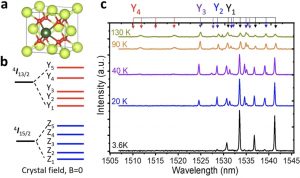
The research team used erbium ions in cerium dioxide, which exhibits very low nuclear spin noise and can be grown directly on silicon. The erbium ions in this system emit light with a sharp spectral line, enabling better precision in photon interactions. The linewidth measured was 440 kilohertz.
The system shows a spin relaxation time of up to 2.5 milliseconds, meaning the spin states last longer before decaying, and an electron spin coherence time of 0.66 microseconds, critical for maintaining quantum information.
This platform offers a combination of silicon compatibility, long spin coherence, and telecom-band operation, making it a strong candidate for building scalable quantum networks that can integrate into existing telecom infrastructure.
The paper’s authors are Jiefei Zhang, Gregory Grant, Ignas Masiulionis, Michael Solomon, Jonathan Marcks, Jasleen Kaur Bindra, Jens Niklas, Alan Dibos, Oleg Poluektov, F. Joseph Heremans, Supratik Guha and David Awschalom, conducting their work at Argonne National Laboratory and the University of Chicago.