How Extreme Pressure Changes Quantum Sensors in Diamond

Elucidating the Intersystem Crossing of the Nitrogen-Vacancy Center up to Megabar Pressures

Physical Review Letters (2026)

Quantum sensors that are made from atomic-scale defects in diamond can operate at pressures above a million atmospheres. Now, a team including scientists from Argonne National Laboratory has found that these pressures also change the sensors themselves, which can make their readings difficult to interpret.

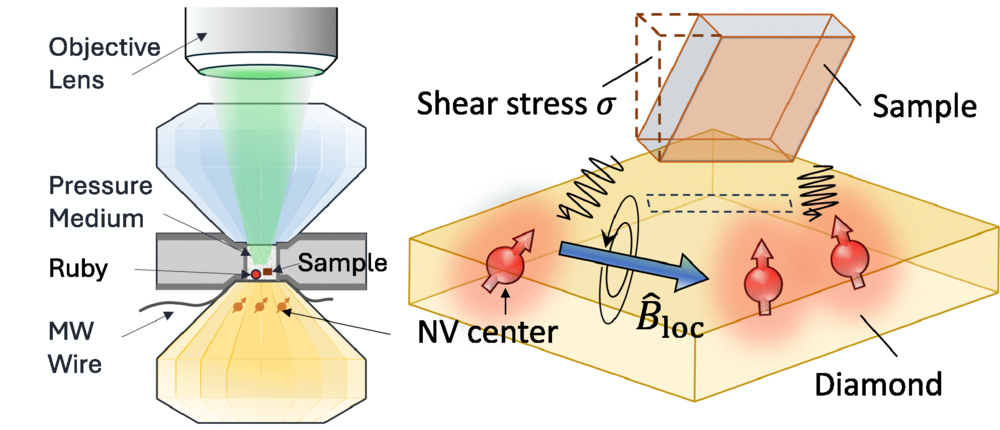
The sensors are nitrogen-vacancy (NV) centers – defects in which a nitrogen atom sits next to a missing carbon atom. Their spin states can be read out optically, which makes them sensitive probes of magnetism and stress.

Researchers place them in diamond anvil cells, which squeeze samples between two diamonds, to study quantum materials and conditions like those inside planets. Using first-principles calculations, along with high-pressure experiments, the team determined how stress alters the NV centers’ optical behaviors.

The researchers found that stress changes the rate of intersystem crossing, a process through which the defect switches spin states without emitting light. Because that process helps to set the strength of the optical readout, stress can enhance the signal or even invert it. The effect depends on whether the stress preserves or breaks the defect’s symmetry.

This framework explains two earlier puzzles: why diamond anvils that are cut along a particular crystal orientation, known as (111), give a stronger signal, and why the signal reverses in certain high-pressure regimes. It also points to a way of improving NV #PressureSensors by controlling the stress each defect experiences. More broadly, this framework suggests that symmetry-breaking stress could be used to tune other spin defects in solids.

The paper authors are Benchen Huang and Yu Jin, from the University of Chicago; Srinivas V. Mandyam, Weijie Wu, Bijuan Chen, Max Block, and Esther Wang, from Harvard University; Bryce Kobrin, Prabudhya Bhattacharyya, and Satcher Hsieh, from UC Berkeley and Berkeley Lab; Chong Zu, from Washington University in St. Louis; Christopher R. Laumann, from Boston University; Norman Y. Yao, from Harvard University, UC Berkeley, and Berkeley Lab; and Giulia Galli, from Argonne National Laboratory and the University of Chicago.

  • David Awschalom wins global Breakthrough of the Year award

    David Awschalom, Q-NEXT Chief Science Officer and the Liew Family Professor of Quantum Engineering and Physics at the University of Chicago, received the prestigious Falling Walls Science Breakthrough of the Year in Physical Sciences for a pioneering body of work that broke the wall between quantum technology, molecules, and proteins. Read More

  • Helium lifts new quantum computing concept

    A team led by Jacob Covey, who is part of Q-NEXT and is an Associate Professor at the University of Chicago, laid out a new concept that could turn helium’s light weight into the next generation of quantum computers. The design relies on helium-3, an isotope with different quantum properties than the helium-4 used to cool MRI machines and fill party balloons. Once built, the computer could use high-powered lasers as “optical tweezers” to capture and control individual atoms of helium. Read More

  • Researchers make materials that support quantum technology

    Researchers from the University of Illinois Urbana-Champaign who are part of Q-NEXT are engineering material systems that support quantum technology. Chris Anderson and his team are developing materials for quantum transduction — the conversion of quantum information from one form to another. Elizabeth Goldschmidt, Daniel Shoemaker, and colleagues are developing quantum memory technology that stores quantum information for extended periods of time. Read More

  • Silicon Chip Offers New Way to Probe Quantum Materials in Strong Magnetic Fields

    Scientists have created a silicon chip that can detect the electrical behavior of very small materials by using very high-frequency waves. The chip is made only from silicon and other non-superconducting materials and still performs very well when cooled from room temperature down to about 4 Kelvin. Read More

  • How Extreme Pressure Changes Quantum Sensors in Diamond

    Scientists have discovered how very high pressures change the behavior of atomic-scale defects, called nitrogen-vacancy centers, in diamond. Nitrogen-vacancy centers are useful because they can act like very small quantum sensors. Read More

  • Making quantum bits ready to use again much sooner

    Scientists from the University of Wisconsin-Madison and Intel have found that a simple electrical pulse can quickly push a quantum dot qubit out of a latched state and return it to its starting condition with very high reliability. Read More

  • Q-NEXT-developed open-source software receives 2026 R&D 100 award

    SeQUeNCe, a free, open-source software developed by Argonne scientists with Q-NEXT support, is one of seven Argonne projects that received a 2026 R&D 100 Award. The SeQUeNCe software lets researchers test how quantum networks might work before building them. Read More

  • Researchers generate spontaneous magnons that synchronize with external signals

    Researchers at Argonne and the University of Illinois Urbana-Champaign demonstrate a method for generating stable ripples in magnetic materials called magnons. The work opens avenues for information processing in microelectronics and quantum devices. Read More

  • Uncovering the hidden disorder in silicon quantum computers

    From the U.S. Department of Energy: Q-NEXT researchers map the variation in materials to the atom level to scale up silicon qubits Read More

  • Color centers in high-purity diamond

    Researchers mapped how electron irradiation makes defects inside diamond, finding that creating more vacancies does not always produce more NV centers. Too many vacancies can form unwanted defects. This result can inform advances in quantum sensing. Read More