 The role of the dopant in the electronic structure of erbium-doped TiO2 for quantum emitters
APL Materials (2024)
In this study, researchers investigate erbium-doped titanium dioxide, or TiO₂, as a material for quantum technologies, focusing on how its structure and defects affect its performance.
Erbium in TiO₂ has potential for use in quantum devices because it interacts with light and can store quantum information. However, defects in the material limit how long quantum states (or light emissions) can last.
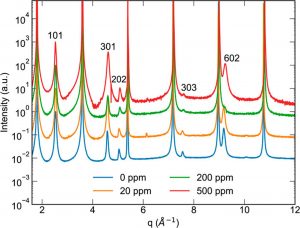
The team used advanced techniques to grow erbium-doped TiO₂ films on sapphire and studied the material’s light-emitting properties and atomic structure using the Advanced Photon Source.
Adding more erbium reduced the time the material could emit light, indicating shorter coherence times (less stability for quantum states). X-ray measurements revealed that erbium atoms take the place of titanium atoms but also cause significant distortions in the surrounding structure. These distortions create additional defects, especially in areas around erbium atoms.
These defects allow energy to decay through unwanted pathways, shortening the material’s ability to emit light coherently. Fixing these issues is essential to make erbium-doped TiO₂ more suitable for quantum technologies.
The paper authors are Jessica Barbosa Martins, Gregory Grant, Daniel Haskel, George Sterbinsky, Ignas Masiulionis, Katie Sautter, Evguenia Karapetrova, Supratik Guha and John Freeland, conducting work at Argonne National Laboratory and the University of Chicago.