 Optical and microstructural characterization of Er3+ doped epitaxial cerium oxide on silicon
APL Materials (2024)
When it comes to building quantum memories, rare-earth ion dopants in solid materials are great qubit candidates. They have two major advantages. 1) The information encoded in a rare-earth ion’s spin can be easily converted into photons and vice versa. 2) Rare-earth ions are easily integrated into solid materials.
One promising system is erbium-doped cerium oxide, or Er:CeO2. The erbium emits light at a wavelength that works with with telecom applications, and the cerium oxide enables relatively long coherence times for the erbium it hosts.
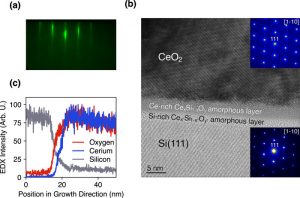
In this study, scientists grew thin films of Er:CeO2 on silicon using a method called molecular beam epitaxy, with erbium concentrations ranging from 2 to 130 parts per million. They then measured how the erbium density affected its spin and photon properties.
Their findings: in the low doping range (2-3 parts per million), the Er:CeO2 exhibited an electron paramagnetic resonance linewidth of 245 MHz, an optical inhomogeneous linewidth of 9.5 GHz, and an optical excited-state lifetime of 3.5 milliseconds. These properties, along with an spectral diffusion linewidth of 5 MHz, indicate that the Er:CeO2 system is an excellent choice to continue quantum memory development.
The study’s authors are Gregory Grant, Jiefei Zhang, Ignas Masiulionis, Swarnabha Chattaraj, Kathryn Sautter, Sean E. Sullivan, Rishi Chebrolu, Yuzi Liu, Jessica Barbosa Martins, Jens Niklas, Alan Dibos, Sumit Kewalramani, John W. Freeland, Jianguo Wen, Oleg Poluektov,F. Joseph Heremans, David D. Awschalom and Supratik Guha, who did their work at Argonne National Laboratory, University of Chicago and Northwestern University.