Elucidating the Intersystem Crossing of the Nitrogen-Vacancy Center up to Megabar Pressures
Physical Review Letters (2026)
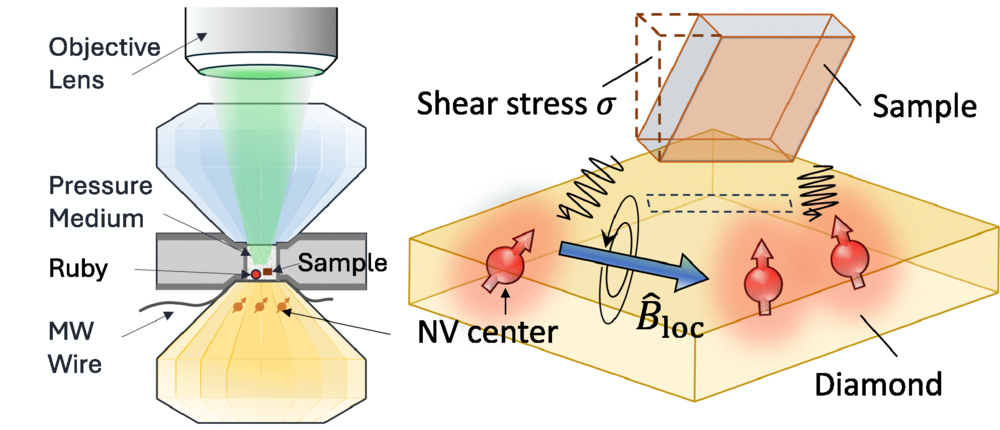
Quantum sensors that are made from atomic-scale defects in diamond can operate at pressures above a million atmospheres. Now, a team including scientists from Argonne National Laboratory has found that these pressures also change the sensors themselves, which can make their readings difficult to interpret.
The sensors are nitrogen-vacancy (NV) centers – defects in which a nitrogen atom sits next to a missing carbon atom. Their spin states can be read out optically, which makes them sensitive probes of magnetism and stress.
Researchers place them in diamond anvil cells, which squeeze samples between two diamonds, to study quantum materials and conditions like those inside planets. Using first-principles calculations, along with high-pressure experiments, the team determined how stress alters the NV centers’ optical behaviors.
The researchers found that stress changes the rate of intersystem crossing, a process through which the defect switches spin states without emitting light. Because that process helps to set the strength of the optical readout, stress can enhance the signal or even invert it. The effect depends on whether the stress preserves or breaks the defect’s symmetry.
This framework explains two earlier puzzles: why diamond anvils that are cut along a particular crystal orientation, known as (111), give a stronger signal, and why the signal reverses in certain high-pressure regimes. It also points to a way of improving NV #PressureSensors by controlling the stress each defect experiences. More broadly, this framework suggests that symmetry-breaking stress could be used to tune other spin defects in solids.
The paper authors are Benchen Huang and Yu Jin, from the University of Chicago; Srinivas V. Mandyam, Weijie Wu, Bijuan Chen, Max Block, and Esther Wang, from Harvard University; Bryce Kobrin, Prabudhya Bhattacharyya, and Satcher Hsieh, from UC Berkeley and Berkeley Lab; Chong Zu, from Washington University in St. Louis; Christopher R. Laumann, from Boston University; Norman Y. Yao, from Harvard University, UC Berkeley, and Berkeley Lab; and Giulia Galli, from Argonne National Laboratory and the University of Chicago.