 Spin-boson mapping of the Quantum Approximate Optimization Algorithm
Physical Review Letters (2026)
The Quantum Approximate Optimization Algorithm (QAOA) is a quantum computing method designed to solve hard optimization problems. In general, making the algorithm deeper — adding more rounds — improves its performance. But studying very deep versions has been difficult because the calculations needed to predict their behavior become overwhelmingly expensive.
In this work, researchers found a new way to study deep QAOA circuits for a well-known optimization problem called the Sherrington–Kirkpatrick model, which describes a complex system of interacting spins.
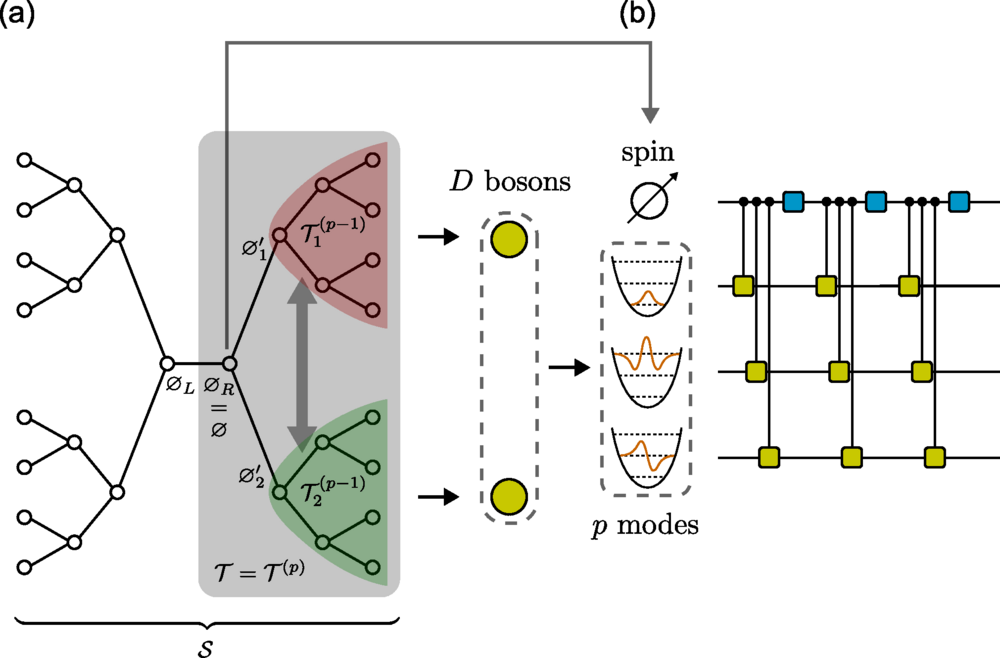
They showed that, for very large systems, the quantum behavior can be effectively described by a model of a single spin interacting with several vibration-like quantum modes. This shortcut made simulations much more efficient, allowing the team to study much deeper QAOA circuits than before — up to depth 160 rather than about 20.
Their results suggest that deeper QAOA circuits can get very close to the best possible answer, providing a new way to understand and improve quantum optimization algorithms.
The paper’s authors are Sami Boulebnane, Abid Khan, Henry Minzhao Liu, Jeffrey Larson, Dylan Herman, Ruslan Shaydulin and Marco Pistoia, who conducted their work at Argonne National Laboratory and JPMorgan Chase.