Thin-film lithium niobate on diamond as a platform for efficient spin-phonon coupling
Physical Review Applied (2025)
Defects in diamond called silicon-vacancy centers are promising building blocks for quantum memory. These defects can be controlled using electromagnetic signals or sound waves. Sound waves are especially attractive because silicon vacancy centers respond strongly to tiny strains in the crystal, allowing strong interactions between vibrations and the defect’s quantum spin.
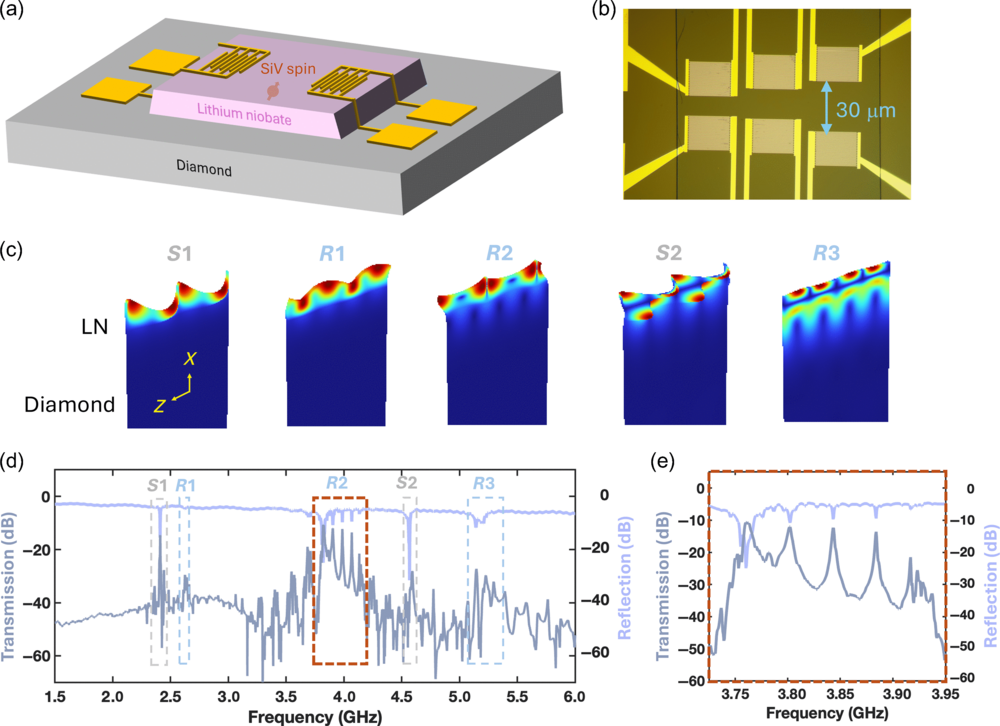
However, diamond itself cannot easily generate these sound waves electrically. To solve this problem, researchers built a hybrid device that combines diamond with a thin layer of lithium niobate, a material that can efficiently produce acoustic waves. Using this platform, they successfully controlled the spin of a single silicon vacancy with sound waves. Their device also improved the speed of this control compared to previous designs.
This work is an important step toward phonon-based quantum technologies, where vibrations in materials are used to process and transmit quantum information on a chip.
The paper’s authors are Zhugjing Xu, Sophie Weiyi Ding, Eliza Cornell, Salma Mohideen, Matthew Yeh, Kazuhiro Kuruma, Leticia Magalhaes, Amirhassan Shams-Ansari, Benjamin Pingault and Marko Loncar, who conducted their work at Harvard University, the AWS Center for Quantum Computing, Stanford University, the University of Tokyo, DRS Daylight Solutions, Argonne National Laboratory and the University of Chicago.