 Spin decoherence dynamics of Er3+ in CeO2 films
Physical Review Letters (2025)
To build large-scale quantum networks, researchers need materials that can connect quantum spins to light at telecom wavelengths — the same ones used in today’s fiber-optic networks. Erbium ions are ideal for this because they naturally emit and absorb light at telecom frequencies and behave like simple quantum spins. But finding a material that keeps these properties intact while working on a silicon chip has been difficult.
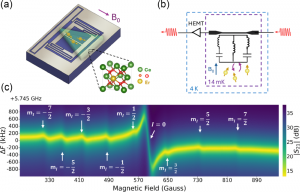
In this paper, Q-NEXT collaborators study thin films of erbium-doped cerium oxide grown on silicon. They show that the erbium spins can stay coherent for tens of microseconds and much longer with special control techniques.
By combining experiments with detailed modeling, they find that the main source of decoherence comes from interactions between nearby erbium spins, and they outline how these effects could be reduced to reach much longer coherence times. This points toward a practical, chip-compatible platform for quantum networking.
This research was conducted by Sagar Kumar Seth, Jonah Nagura, Vrindaa Somjit, Aneesh Bapat, Xinhao Li, Gregory Grant, Ignas Masiulionis, Xu Han, F. Joseph Heremans, Giulia Galli, David D. Awschalom, Supratik Guha and Jiefei Zhang, who conducted their work at the University of Chicago and Argonne National Laboratory.