 Microstructural and preliminary optical and microwave characterization of erbium-doped CaMoO4 thin films
APL Materials (2025)
Researchers are developing thin films made of calcium molybdate, with small amounts of erbium added, as a possible material for quantum light sources that work at telecom wavelengths (around 1.5 micrometers). These sources could be useful for building quantum communication networks.
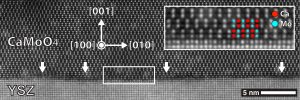
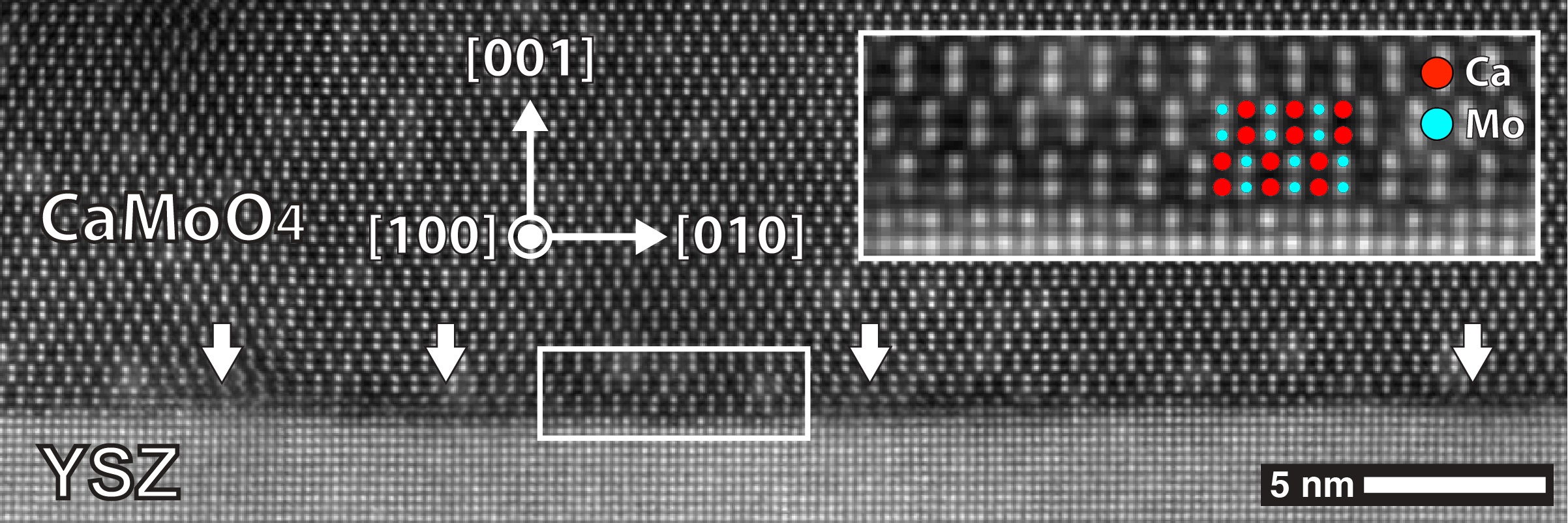
As detailed in this paper, using a precise growth technique called molecular beam epitaxy, they figured out how to grow high-quality films with the right chemical balance so the desired material forms and the erbium atoms can be added in controlled amounts during the deposition. When grown on silicon, the films form many crystalline grains. But when grown on a different base material, yttria-stabilized zirconia, they grow as a single, well-ordered crystal.
The team also studied optical and magnetic properties of these films, finding that the erbium ions emit light with narrow linewidths and have long-lived optical excited states — features that make them promising candidates for quantum memory and communication devices.
The paper’s authors are Ignas Masiulionis, Bonnie Lin, Sagar Kumar Seth, Gregory Grant, Wanda Lindquist, Sungjoon Kim, Junghwa Kim, Angel Yanguas-Gil, Jeffrey Elam, Jiefei Zhang, James LeBeau, David Awschalom, and Supratik Guha, who conducted their work at the University of Chicago, Argonne National Laboratory, MIT, and the Chicago Quantum Exchange.
This work was supported by the U.S. Air Force Office of Scientific Research, the U.S. Department of Energy Office of Basic Energy Sciences, and the U.S. Department of Energy Advanced Materials and Manufacturing Technology Office.