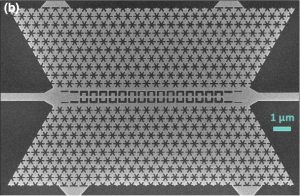
 Two-dimensional optomechanical crystal resonator in gallium arsenide
Physical Review Applied (2024)
In quantum computing and communication, scientists are working on ways to smoothly convert quantum information between microwave electronics and infrared optics.
One promising solution is a device called an optomechanical crystal resonator, which allows microwave-frequency sound waves to interact with infrared light waves. The cavity can be used to convert a microwave signal into something that can be used over telecom fiber optics.
Previous resonator designs had the advantages of strong optomechanical coupling and low energy loss. But they struggled to handle the heat dissipation, or they operated at a mechanical frequency that was not well suited to quantum computing.
In this paper, researchers adapted the designs to use gallium arsenide. Gallium arsenide has a slower acoustic wave speed, allowing the resonator to operate at a frequency compatible with superconducting qubits. Also, the material’s piezoelectric properties could enable direct coupling to an electrical circuit in future applications.
The team achieved a mechanical resonance frequency of 4.5 gigahertz, which is perfect for superconducting qubits. They also demonstrated strong optomechanical coupling, with a rate of 650 kilohertz.
The researchers for this study are Rhys Povey, Ming-Han Chou, Gustav Andersson, Christopher Conner, Joel Grebel, Yash Joshi, Jacob Miller, Hong Qiao, Xuntao Wu, Haoxiong Yan and Andrew Cleland, conducting their work at University of Chicago and Argonne National Laboratory.