
 Distinguishing homolytic vs heterolytic bond dissociation of phenylsulfonium cations with localized active space methods
Journal of Chemical Physics (2024)
Modeling chemical reactions on a quantum computer is difficult because of the changes in electronic structure during the reaction and imperfections on near-term devices, which could lead to poor orbital optimizations.
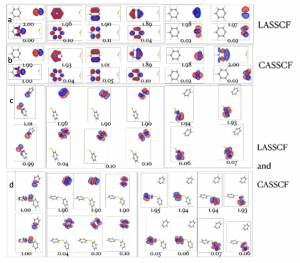
Multireference methods, such as complete active space self-consistent field (CASSCF) can describe these changes of electronic structures. The localized active space self-consistent field (LASSCF) is a cheaper alternative to CASSCF for it further divides the complete active space into several weakly interacting fragments.
As detailed in this paper, scientists have for the first time used the LASSCF method to study a chemical reaction: the bond breaking of mono-, di-, and triphenylsulfonium cations.
They found that LASSCF calculations produce smooth potential energy plots more easily than the more computationally expensive CASSCF calculations while predicting similar bond dissociation energies. LASSCF orbitals are also more robust than CASSCF’s along the reaction, which suggests that LASSCF orbitals may be more appealing for near-term quantum devices to study chemical reactions. Lastly, their calculations suggest a homolytic bond cleavage for di- and triphenylsulfonium and a heterolytic pathway for monophenylsulfonium.
The work is important for the development of materials for quantum communication, computing and sensing.
The paper was authored by Qiaohong Wang, Valay Agarawal, Matthew R. Hermes, Mario Motta, Julia E. Rice, Gavin O. Jones and Laura Gagliardi, who conducted work at the University of Chicago, IBM and Argonne National Laboratory.