 Classical algorithm for simulating experimental Gaussian boson sampling
Nature Physics (2024)
Gaussian boson sampling is a specific type of quantum computing that isn’t fully universal but has been seen as a strong candidate for demonstrating quantum advantage.
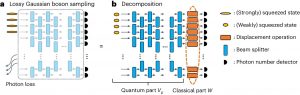
In this paper, a team introduced a classical algorithm based on tensor networks that can simulate the most recent noisy Gaussian boson sampling experiments.
The efficiency of this algorithm improves significantly when there’s a high rate of photon loss, which is common in current experiments. Using the algorithm and the Argonne Leadership Computing Facility supercomputer Polaris, the team managed to simulate the largest Gaussian boson sampling experiment to date using relatively modest computational resources.
Their findings suggest that their classical simulator can mimic the noisy Gaussian boson sampling distribution more accurately than the actual noisy experiment can, which raises the bar for claiming quantum advantage for real experiments with various imperfections.
The paper authors are Changhun Oh, Minzhao Liu, Yuri Alexeev, Bill Fefferman and Liang Jiang, who did their research at Argonne National Laboratory, Korea Advanced Institute of Science and Technology and the University of Chicago.