 Coherent spin-control of S = 1 vanadium and molybdenum complexes
Chemical Science (2024)
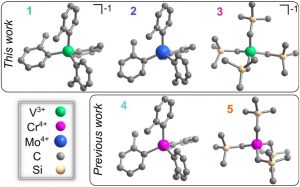
Previously, a research team supported by Q-NEXT developed molecular qubits with a quantum state centered on a chromium (Cr4+) ion that could interact with light — a qubit type that is expected to be useful for quantum sensing.
In this paper, a research team explores two similar ions — vanadium (V3+) and molybdenum (Mo4+) — to learn if they could offer advantages for quantum sensing.
The research team found that vanadium (V3+) and molybdenum (Mo4+) in specific states could be controlled effectively. But unlike their chromium (Cr4+) cousin, the two molecules did not emit light when excited. Results suggest that the structure of these molecules could be modified to enable light emission.
The researchers outline molecular design features suited to quantum sensing applications using vanadium- or molybdenum-based systems.
The study was conducted by Daniel Laorenza, Kathleen Mullin, Leah Weiss, Sam Bayliss, Pratiti Deb, David Awschalom, James M. Rondinelli and Danna Freedman, who did their work at MIT, Northwestern University, the University of Chicago, Tohoku University, the University of Glasgow and Argonne National Laboratory.