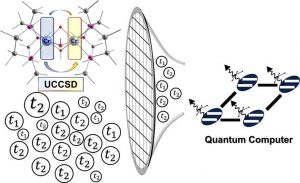
 The localized active space method with unitary selective coupled cluster
Journal of Chemical Theory and Computation (2024)
Scientists introduce in this study a new hybrid quantum-classical algorithm called the LAS-USCCSD method, which is designed to solve complex quantum chemistry problems efficiently.
The algorithm starts with a classical computation, calculating the basic structure and energy levels of a molecule by breaking it into smaller parts. It then selects the most important parameters, the variables that control the interaction energy between different parts of the molecule. Finally, the algorithm uses a quantum computing method called the variational quantum eigensolver to focus only on the important parameters. This makes the quantum part of the computation more efficient by reducing the amount of data the quantum computer must process.
The new LAS-USCCSD algorithm is more efficient than its predecessor LAS-UCCSD method. It requires fewer parameters to get accurate results, so calculations are faster and simpler. This reduced complexity makes it more practical to implement on near-term quantum computers.
The team tested the algorithm on molecules (H₂)₂, (H₂)₄, and trans-butadiene, as well as on a complex bimetallic molecule. The new method required up to 10 times fewer parameters and reduced the complexity of the quantum computations.
The authors of this result are Abhishek Mitra, Ruhee D’Cunha, Qiaohong (Joanna) Wang, Matthew Hermes, Yuri Alexeev, Stephen Gray, Matthew Otten and Laura Gagliardi, who conducted their work at the University of Chicago, Argonne National Laboratory and the University of Wisconsin-Madison.