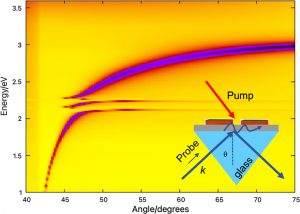
 Ultrafast dynamics of plasmon-coupled excitons in semiconducting nanoplatelets
Journal of Physical Chemistry C (2025)
Researchers explore how certain tiny materials — semiconductor nanoplatelets — interact with special light waves known as surface plasmon polaritons (SPPs), which travel along the surface of metals such as silver.
When excitons (bound pairs of an electron and a hole created when light hits a semiconductor) interact with SPPs, the result is tunable and very fast optical behavior — ideal for advanced photonics such as lasers, sensors and quantum devices.
In this study, the team compared two systems: nanoplatelets and quantum dots. Both were placed on thin silver films that support SPPs. They found that nanoplatelets interacted more strongly and more quickly with the plasmons than did quantum dots. This is mainly because nanoplatelets have a larger surface area that lies flat on the metal, creating a better interface.
The researchers also developed a theoretical model to explain and predict the behavior they observed.
The group’s work could lead to faster, tunable, more efficient light-based technologies and quantum emitters.
The papers authors are Wei Wang, Daniel Rosenmann, Yuzi Liu, Xuedan Ma, Wooje Cho, Joshua Portner, Ruiming Lin, Dmitri Talapin, Ralu Divan, David Gosztola, Stephen Gray and Gary Wiederrecht, working at Argonne National Laboratory, the University of Chicago and Rice University.