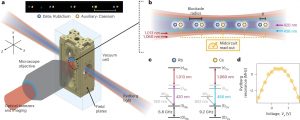
 A dual-species Rydberg array
Nature Physics (2024)
Researchers use arrays of atoms trapped in optical tweezers to perform quantum simulation and computation. Some advanced quantum tasks, such as quantum error correction, require operations during the computation, such as resetting or reading out the state of a subset of qubits in the middle of the circuit operation.
To achieve these advanced tasks, a team developed a quantum system using two types of atoms: rubidium and cesium.
By carefully tuning the energy states of the atoms, the team increased the interaction between rubidium and cesium atoms. With these enhanced interactions, they successfully transferred a quantum state from one atom type to the other. They also created a Bell state — a fundamental entangled state — between rubidium and cesium atoms, showing they could entangle qubits of different atomic types. Finally, they performed quantum nondemolition measurements (a measurement method that doesn’t disturb the system much), allowing for midprocess readouts.
This dual-species Rydberg array enables new quantum operations not possible with a single species, which brings researchers closer to practical quantum error correction and other advanced quantum protocols.
The team members are Shraddha Anand, Conor Bradley, Ryan White, Vikram Ramesh, Kevin Singh and Hannes Bernien, who conducted their research at the University of Chicago.