Spectral diffusion of nanomechanical resonators due to single quantum defects
Phys Rev Applied (2025)
Tiny mechanical devices called nanomechanical resonators can vibrate at very precise frequencies and are useful for ultrasensitive measurements and quantum technologies. For these devices to work well, their vibrations need to last a long time and stay stable. But at very low temperatures, microscopic flaws in the material, known as two-level system (TLS) defects, cause energy loss and unpredictable frequency shifts.
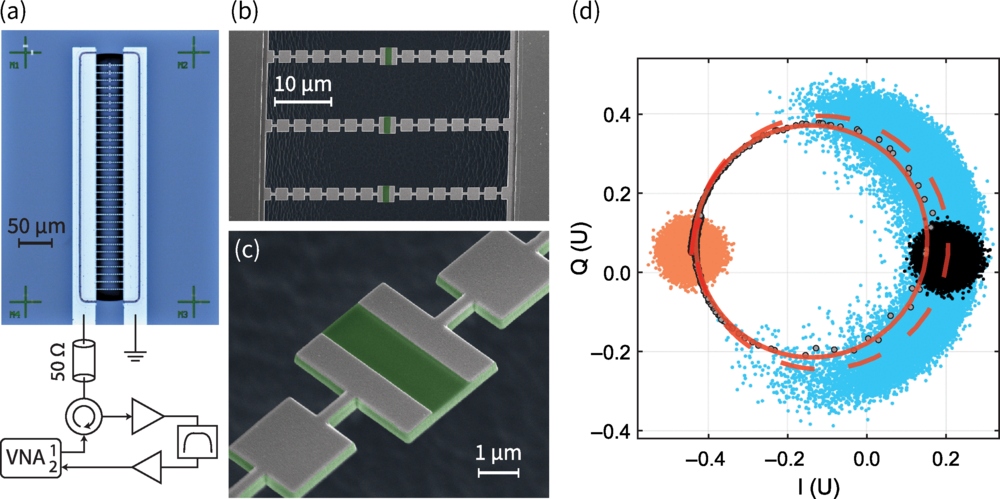
In this study, researchers examined how these fluctuations behave by tracking the vibrations of nanoscale resonators made from phononic crystals — structures that control how sound waves move. They observed sudden jumps in frequency, which suggest that individual TLS defects were flipping between two states. Their results show that these random shifts come from strong interactions between the resonator’s vibrations and individual defects rather than from large groups of them. Understanding this behavior points the way to reducing noise and improving performance in quantum sensors and other precision technologies.
The paper’s authors are Matthew Maksymowych, Mert Yüksel, Oliver Hitchcock, Nathan Lee, Felix Mayor, Wentao Jiang, Michael Roukes and Amir Safavi-Naeini, who conducted this work at the Stanford University and Caltech.