Parallelized telecom quantum networking with an ytterbium-171 atom array
Nature Physics (2025)
Quantum networks link quantum computers and sensors together, but most systems use light at visible wavelengths, which doesn’t travel far in fiber without converting to the telecom band — an inefficient process that adds noise.
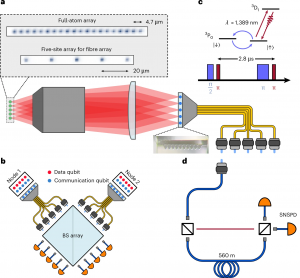
As detailed in this Nature Physics paper, researchers directly created high-quality entanglement between ytterbium atoms and photons at telecom wavelengths, eliminating the need for conversion. They entangled the atom’s nuclear spin with a single photon and achieved very high fidelity, which can be further improved by correcting photon measurement errors.
They also showed how to scale up the system: by aligning arrays of atoms with arrays of optical fibers, they could entangle multiple atoms in parallel, boosting communication rates. Importantly, they preserved the memory of one qubit while performing operations on others.
Together, these results demonstrate a promising path toward building scalable quantum networks that integrate atomic systems directly into existing telecom infrastructure.
The paper’s authors are Lintao Li, Xiye Hu, Zhubing Jia, William Huie, Won Kyu Calvin Sun, Aakash, Yuhao Dong, Narisak Hiri-O-Tuppa and Jacob Covey, who conducted their work at the University of Illinois Urbana-Champaign.