 Moiré-assisted strain transfer in vertical van der Waals heterostructures
Nano Letters (2023)
When it comes to quantum information engineering, there’s great potential for using 2D van der Waals (vdW) materials. These can be stacked layer by layer at arbitrary twist angles to produce intriguing quantum phenomena.
One of the tools for manipulating vdW materials is strain, which can be used to tune the material’s band structure and alter its energy levels. Strain is a versatile method for fine-tuning materials, yet the possibilities for using it in 2D vdW structures are relatively unexplored.
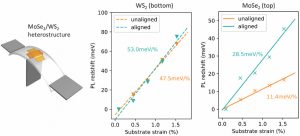
In this study, scientists at set out to measure how well strain can be transferred from one layer in the vdW structure to another.
The team stacked layers of transition metal dichalcogenides (TDMC) on a flexible surface, which allowed them to measure the strain in each layer separately, twisting each layer as it was stacked. They found that in TDMC structures with twist angles of less than 5 degrees, the strain transfers efficiently.
Their findings open possibilities for engineering materials that can be used in quantum computing, communication and sensing.
The study’s authors are Jenny Hu, Leo Yu, Xueqi Chen, Wanhee Lee, C. Mathew Mate and Tony F. Heinz, who conducted their research at Stanford University and SLAC National Accelerator Laboratory.