 Reconfigurable dissipative entanglement between many spin ensembles: from robust quantum sensing to many-body state engineering
Physical Review X (2026)
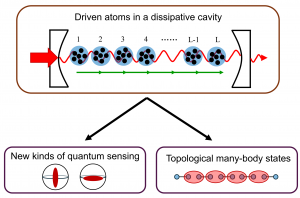
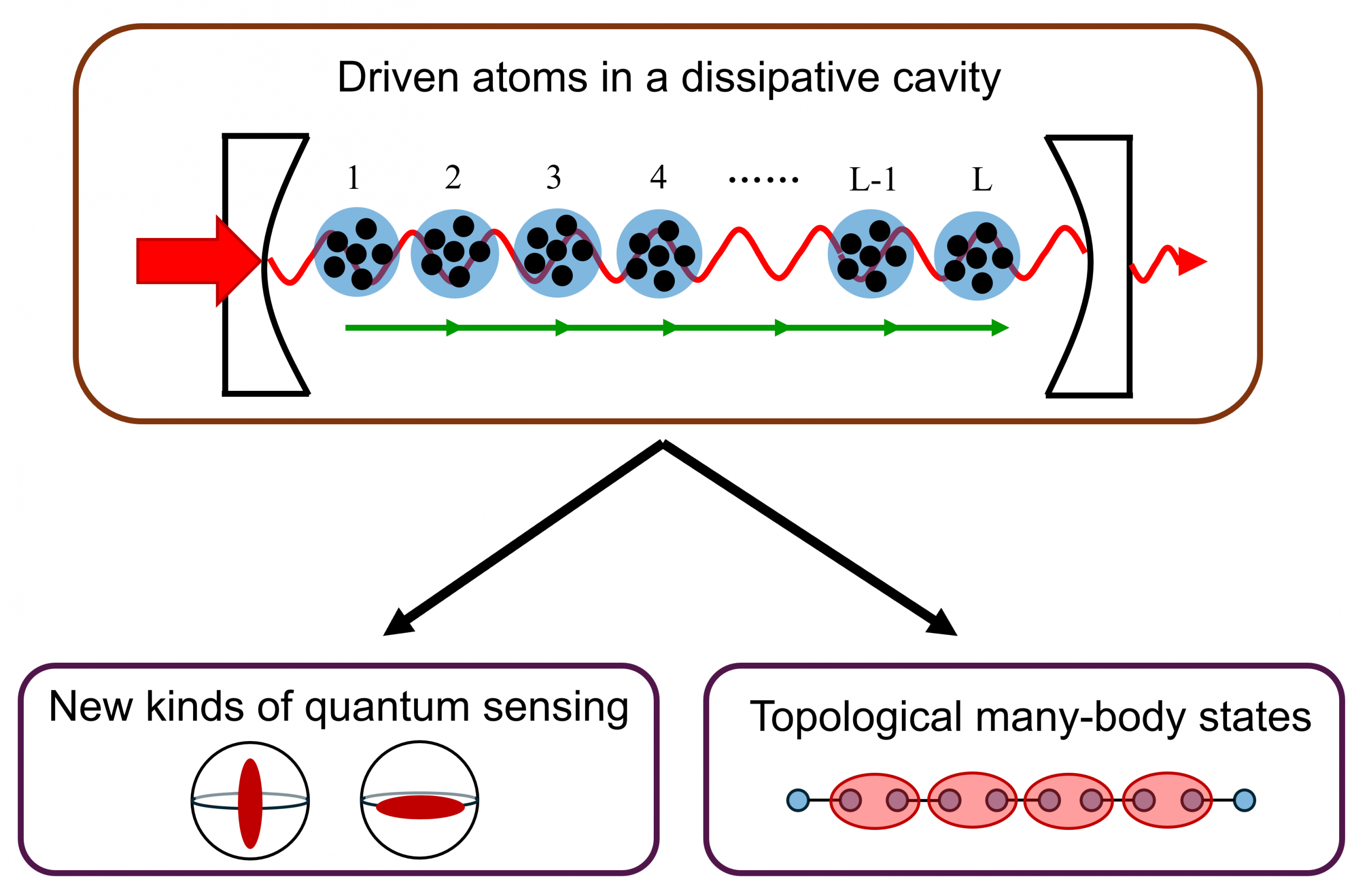
One way to build reliable quantum technologies is to create entangled states that naturally remain stable instead of quickly falling apart. One promising approach is to carefully engineer how a quantum system loses energy so that it settles into the desired entangled state. However, most existing methods are either limited to relatively simple states or require many complicated control processes.
In this paper, researchers introduce a much simpler method that uses a single type of collective energy loss, combined with straightforward controls that are already available in many cavity quantum electrodynamics experiments. By dividing the spins into groups, their approach can create and stabilize a wide variety of highly entangled quantum states.
The technique could improve quantum sensors, allowing them to measure tiny changes in magnetic or electric fields with the highest possible precision while automatically rejecting noise that affects all sensors equally. It can also create more exotic quantum states with special topological properties, including the well-known Affleck-Kennedy-Lieb-Tasaki (AKLT) state, which is of great interest in quantum physics.
The work provides a simpler and more flexible way to prepare complex entangled states for quantum sensing and quantum information applications.
The paper was written by Anjun Chu, Mikhail Mamaev, Martin Koppenhöfer, Ming Yuan and Aashish Clerk, who conducted their work at the University of Chicago and Fraunhofer Institute for Applied Solid State Physics.