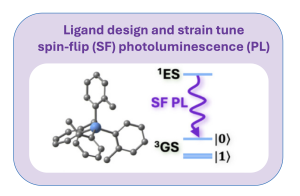
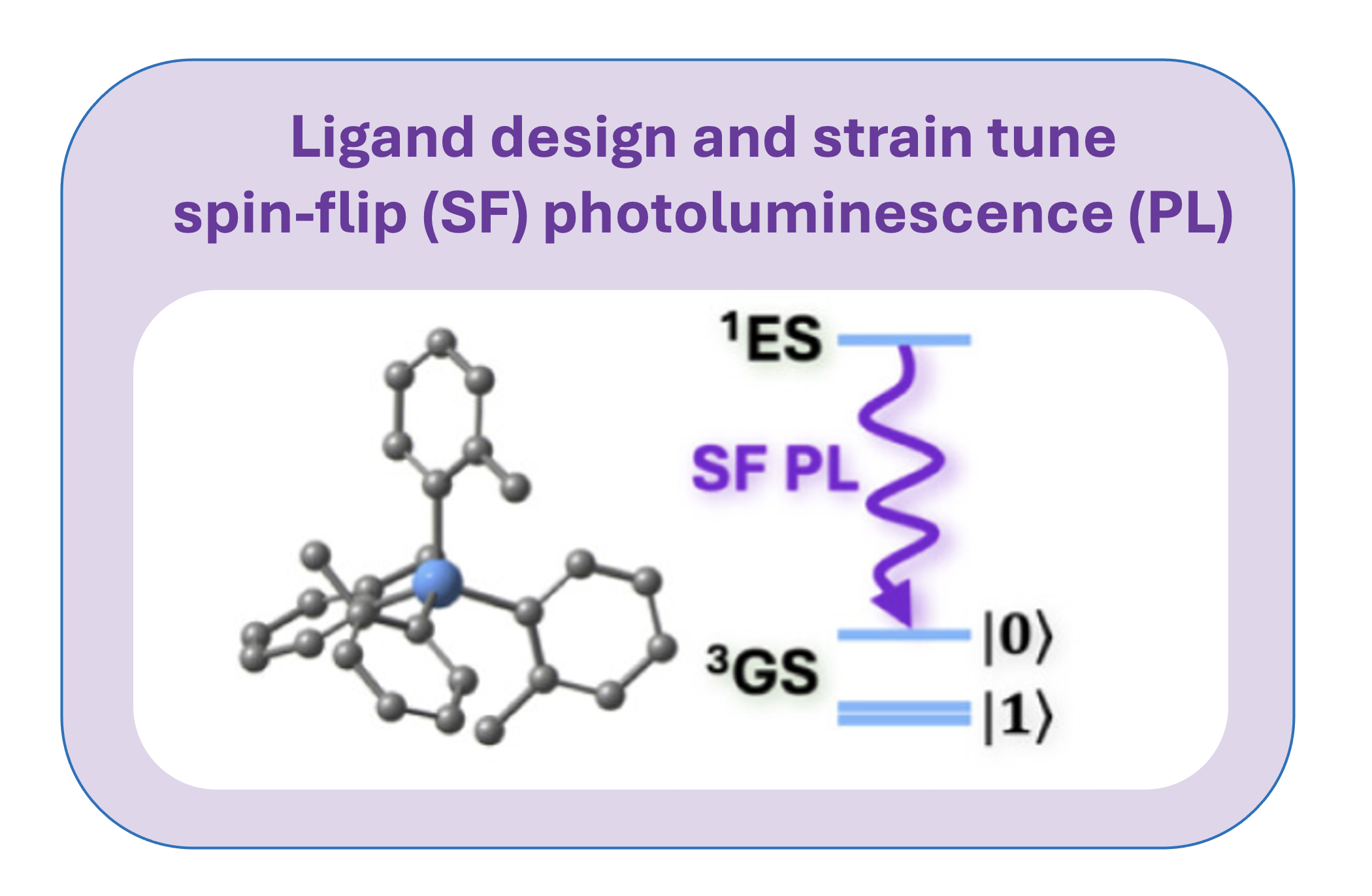
 Harnessing the spin-flip radiative lifetimes of optically addressable molecular qubits
Journal of the American Chemical Society (2026)
Certain molecules containing chromium or molybdenum can act as quantum bits, or qubits, and can be controlled and read out using light. One important property of these molecular qubits is how quickly they emit light during a special type of transition called a spin-flip transition, affecting how efficiently a quantum state can be measured.
In this paper, researchers used computer simulations to uncover what controls the brightness and lifetime of spin-flip light-emitting transitions. They found that the behavior depends on the molecule’s electronic structure, symmetry and the way the metal atom bonds to surrounding atoms. These properties can be adjusted through molecular design and by applying strain to the material. The results provide a roadmap for engineering molecular qubits with better optical and quantum performance for future sensing and quantum information technologies.
Diego Sorbelli and Giulia Galli conducted this research at the University of Perugia and the University of Chicago.