
Metasurfaces for quantum communication and sensing

GHz-speed wavefront shaping metasurface modulators enabled by resonant electro-optic nanoantennas

Advanced Materials (2025)
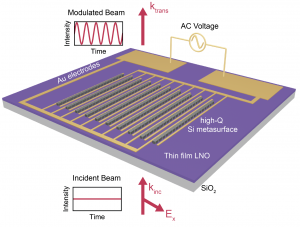
 

In this paper, scientists detail how they have developed a new kind of ultrathin optical device, or metasurface, that can control light using electrical signals. These devices are made of tiny silicon antennas that sit on a special material called lithium niobate.

By applying a small voltage, they can change how much light passes through and how the light waves bend or shift — important functions for quantum communication and sensing. This design works well at telecom wavelengths, reaches high speeds (over 1 GHz), and can be manufactured using modern foundry-scale methods.

The team also demonstrated a version that can split light beams and adjust their strength quickly, making this technology promising for fast, compact optical systems like those used in wireless data transmission, advanced sensors, and solid-state components that can potentially be used to create reconfigurable entangled quantum optical resources.

The research was conducted by Sahil Dagli, Jiyong Shim, Hamish Carr Delgado, Halleh Balch, Sajjad Abdollahramezani, Chih-Yi Chen, Varun Dolia, Elissa Klopfer, Jefferson Dixon, Jack Hu, Babatunde Ogunlade, Jung-Hwan Song, Mark Brongersma, David Barton and Jennifer Dionne, who conducted their research at Stanford University, National University of Singapore and Northwestern University.

News and features

See all news and features
  • David Awschalom wins global Breakthrough of the Year award

    David Awschalom, Q-NEXT Chief Science Officer and the Liew Family Professor of Quantum Engineering and Physics at the University of Chicago, received the prestigious Falling Walls Science Breakthrough of the Year in Physical Sciences for a pioneering body of work that broke the wall between quantum technology, molecules, and proteins. Read More

  • Helium lifts new quantum computing concept

    A team led by Jacob Covey, who is part of Q-NEXT and is an Associate Professor at the University of Chicago, laid out a new concept that could turn helium’s light weight into the next generation of quantum computers. The design relies on helium-3, an isotope with different quantum properties than the helium-4 used to cool MRI machines and fill party balloons. Once built, the computer could use high-powered lasers as “optical tweezers” to capture and control individual atoms of helium. Read More

  • Researchers make materials that support quantum technology

    Researchers from the University of Illinois Urbana-Champaign who are part of Q-NEXT are engineering material systems that support quantum technology. Chris Anderson and his team are developing materials for quantum transduction — the conversion of quantum information from one form to another. Elizabeth Goldschmidt, Daniel Shoemaker, and colleagues are developing quantum memory technology that stores quantum information for extended periods of time. Read More

  • Q-NEXT-developed open-source software receives 2026 R&D 100 award

    SeQUeNCe, a free, open-source software developed by Argonne scientists with Q-NEXT support, is one of seven Argonne projects that received a 2026 R&D 100 Award. The SeQUeNCe software lets researchers test how quantum networks might work before building them. Read More

  • Researchers generate spontaneous magnons that synchronize with external signals

    Researchers at Argonne and the University of Illinois Urbana-Champaign demonstrate a method for generating stable ripples in magnetic materials called magnons. The work opens avenues for information processing in microelectronics and quantum devices. Read More