
 Laser cooling and qubit measurements on a forbidden transition in neutral Cs atoms

Phys Rev Lett (2025)
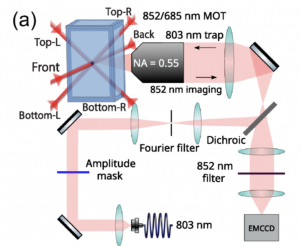
In this paper, researchers detail how they developed a way to measure the quantum state of a single cesium atom without adding background noise. They cool each atom to about 5 microkelvin and use a special type of light transition to read out its hyperfine state (a very fine energy difference inside the atom). This method identifies the atom’s state with 99.93% accuracy and keeps the atom trapped 99.54% of the time, with most losses coming only from the limits of the vacuum system.
Because the measurement happens while the atom is being cooled in 3D, they can repeat the measurement many times without losing the atom. They also analyze a future version of the technique and show it could reach even higher accuracy — about 99.95% in just 60 microseconds — by adding another laser to quickly reset the excited state.
The paper’s co-authors are Jacob Scott, Hong Ming Lim, Uday Singla, Quinn Meece, Jennifer Choy, Shimon Kolkowitz, Trent Graham and Mark Saffman, who conducted their research at the University of Wisconsin–Madison, the University of California, Berkeley, and @Infleqtion.