Efficient measurement of neutral-atom qubits with matched filters
Physical Review Applied (2026)
Quantum computers need to accurately measure the state of many qubits at once. In neutral-atom quantum computers, where qubits are packed closely together, light from one atom can interfere with measurements of nearby atoms, creating errors known as readout crosstalk.
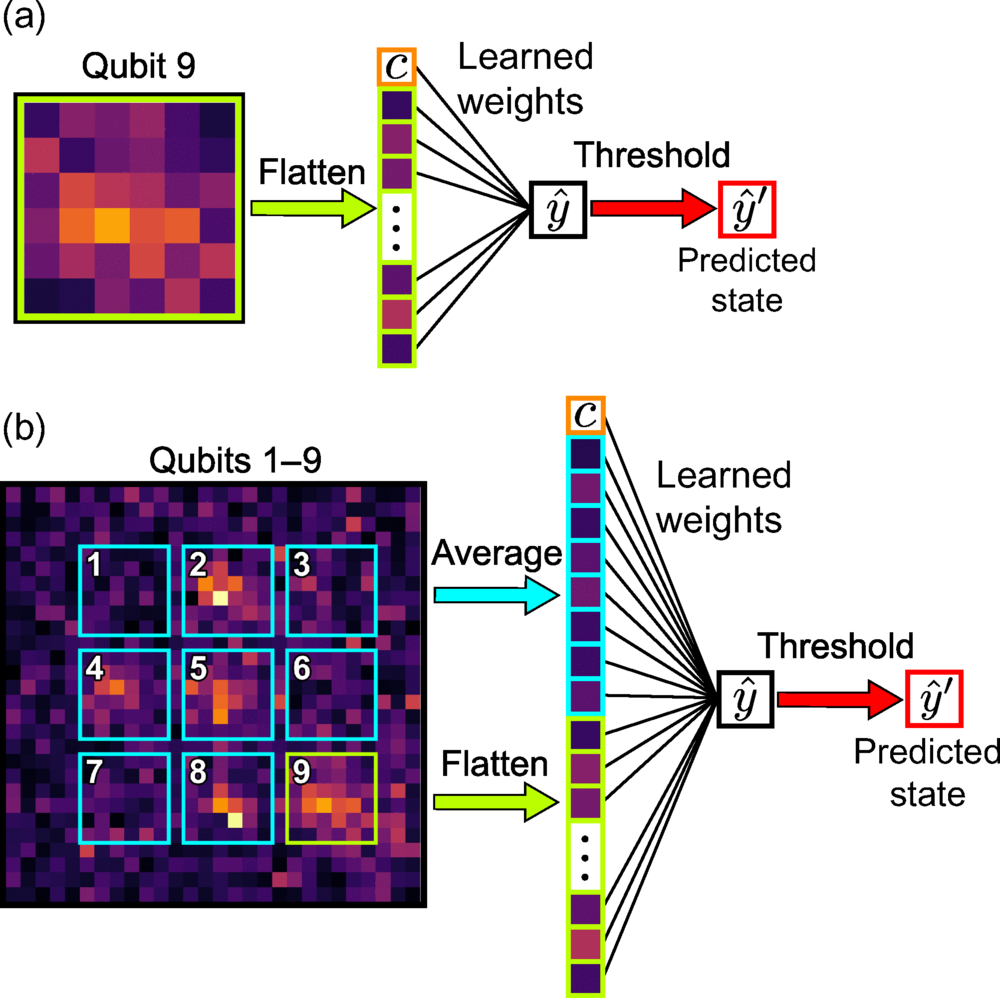
Researchers have previously used complex artificial intelligence methods to reduce these errors, but those approaches require a lot of computing power and become difficult to scale as the number of qubits grows. In this paper, researchers developed two simpler machine-learning methods that can identify qubit states more accurately while using far fewer computational resources. One method analyzes each qubit individually, while the other also considers information from neighboring qubits to correct for crosstalk.
The new approaches reduced measurement errors by up to 43%, ran hundreds of times faster than previous AI methods, and required dramatically fewer parameters and calculations. Because the models are simpler, researchers can also inspect them to better understand the sources of experimental errors. The results suggest that efficient, interpretable machine-learning tools can help enable reliable measurements in larger quantum computers.
The paper authors are Robert Kent, Linipun Phuttitarn, Chaithanya Naik Mude, Swamit Tannu, Mark Saffman, Gregory Lafyatis and Daniel Gauthier, who conducted their work at Ohio State University and the University of Wisconsin–Madison, Infleqtion and ResCon Technologies.
Image is taken from Fig. 1 of ref. DOI:10.1103/x3h2-nz8y with permission of the authors.