 The origin of single-molecule sensitivity in label-free solution-phase optical microcavity detection
ACS Nano (2025)
Q-NEXT collaborators are advancing quantum sensing for medicine and materials science.
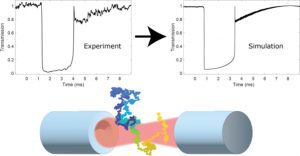
The study explains how fiber Fabry-Perot microcavities (FFPCs) — tiny optical cavities that trap and enhance light — are used to detect single biomolecules in a liquid without needing labels or markers. Scientists demonstrate how these cavities make light-matter interactions much stronger, providing unprecedented sensitivity without the need for chemical labeling.
The technique relies on tiny temperature changes caused by molecules interacting with the microcavity. The FFPC is kept in an unstable state so that even the smallest disturbances — such as a passing biomolecule — cause a noticeable shift in the system’s thermal and optical properties.
The team found that when a molecule moves randomly (Brownian motion) through the cavity, it creates tiny resonance fluctuations — less than 1/1,000th of the system’s already narrow sensitivity range. These small changes trigger a large and selective response due to a specific range of molecular motions called the molecular velocity filter window, meaning only molecules moving within a certain speed range cause detectable shifts.
This method of quantum sensing opens the door to new ways of studying the size and shape of single molecules, which could be useful in medicine, drug discovery and advanced materials research.
The paper’s authors are Carlos Andres Saavedra Salazar, Daniel Sole-Barber, Sushu Wan, Julia Rasch, Michael Reitz, Brendan Cullinane, Nasrin Asgari, Lisa-Marie Needham, Joel Yuen-Zhou and Randall Goldsmith, conducting work at the University of Wisconsin–Madison.