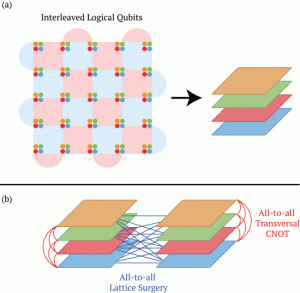
 Interleaved logical qubits in atom arrays
2025 IEEE International Symposium on High Performance Computer Architecture (HPCA)
Neutral atom arrays are a promising technology for quantum computers, but moving the atoms around — something many designs rely on — could slow computations so much that it cancels the speed advantage of quantum processing.
In this study, scientists propose a new “movement-free” design for quantum error correction that organizes qubits into interleaved groups, allowing fast, reliable operations within each group and efficient communication between groups. Simulations show this setup could make computations about three times faster in highly parallel tasks, while still working well even if error rates are moderately higher.
The approach uses two types of atoms with different interaction strengths, which has already been demonstrated in experiments, and could inspire new hardware that enables longer-range, high-quality quantum operations.
The study was co-authored by Joshua Viszlai, Sophia Lin, Siddharth Dangwal, Conor Bradley, Vikram Ramesh, Jonathan Baker, Hannes Bernien and Fred Chong, who conducted their research at the University of Chicago and the University of Texas at Austin.