
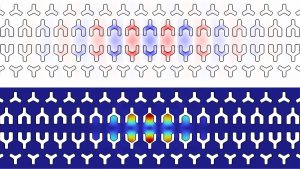
 High photon-phonon pair generation rate in a two-dimensional optomechanical crystal
Nature Communications (2025)
A team of researchers worked on tiny devices that use light and vibrations to process and transfer quantum information. However, these devices often overheat, which limits their performance.
The team designed a new type of structure — a two-dimensional optomechanical crystal (OMC) — that cools down much better than previous designs. The new OMC has a vibration mode at 7.4 GHz, making it a good match for existing quantum hardware.
The study shows that the device has strong interactions between light and vibrations, stays cool more effectively and maintains high optical quality. This allows it to reach an extremely low-energy state, close to the absolute quantum ground state, while maintaining low temperatures. It also produces entangled pairs of light and sound particles, which could be useful for future quantum technologies.
The breakthrough could help create better connections between microwave-based quantum computers and optical communication networks, improving the way quantum information is shared and processed.
The paper’s authors are Felix Mayor, Sultan M., André Garcia Primo, Samuel Gyger, Wentao Jiang, Thiago Alegre and Amir Safavi-Naeini, conducting work at Stanford University and the Universidade Estadual de Campinas.