 Lateral beam shifts and depolarization upon oblique reflection from dielectric mirrors
Annalen der Physik (2024)
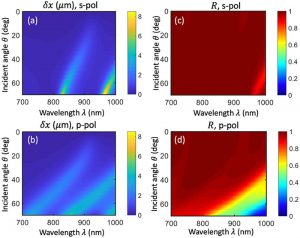
Dielectric mirrors made of thin-film layers are commonly used in optical experiments because they reflect light better than metal mirrors. However, when these mirrors are used at an angle and with focused light beams, they can cause problems like distorted beam shapes and changes in polarization. These effects depend on factors like the wavelength of light, angle of incidence and polarization of the incoming light.
In this paper, scientists designed and simulated different types of dielectric mirrors. The team measured the beam shift from two commercial dielectric mirrors and one metal mirror with a coating. Their work highlights the pros and cons of using dielectric mirrors versus metal mirrors in certain optical experiments.
Their work aids the development of devices for quantum communication and sensing.
The work was carried about by Yuzhe Xiao, Linipun Phuttitarn, Trent Graham, Chenghao Wan, Mark Saffman and Mikhail Kats, who conducted their work at the University of Wisconsin-Madison.