 Low-loss millimeter-wave resonators with an improved coupling structure
Superconductor Science and Technology (2024)
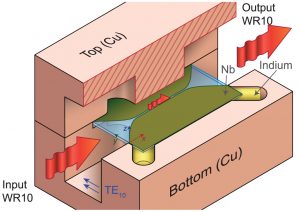
Millimeter-wave superconducting resonators are handy for studying how well quantum devices work at higher frequencies, but designing a way to measure them presents challenges. While the resonators are tiny 2-D structures on the surface of a sapphire chip, the high-frequency measurement signals arrive as uniform fields in a larger 3-D waveguide. Not only can the sapphire reflect some of the signal, but everything on the chip interacts indiscriminately with the signal, making it hard to design more complicated circuits.
In this study, scientists have found a way to take control of the millimeter-wave signals. Their design includes a special structure for compressing signals into a slim 2-D waveguide, which can direct where on the chip the energy travels. This structure ensures that more than 90% of the signal strength is retained across a bandwidth of 14 GHz.
The team tested the setup with resonators placed near the 2-D waveguide. They found they could control how the resonators interact without increasing signal loss. By combining the resonator design with the team’s fabrication process, they’ve created devices that outperform existing millimeter-wave resonators.
The paper authors are A. Anferov, S. P. Harvey, F. Wan, K. H. Lee, J. Simon and David Schuster, conducting work at Stanford University, SLAC National Accelerator Laboratory and the University of Chicago.