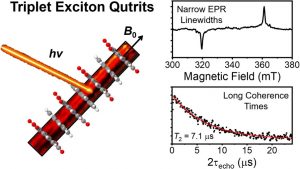
 Oriented triplet excitons as long-lived electron spin qutrits in a molecular donor–acceptor Single cocrystal
Journal of the American Chemical Society (2023)
Unpaired electron spins in molecules are promising for quantum information science. The spins can be precisely controlled and arranged into multilevel quantum states, enabling greater information processing. But they have their challenges: Individual spins are difficult to manipulate, and their coherence time is short.
In this study, scientists find that using special crystals as a host for these electron spins produces well defined signals, allowing greater control over the spin states. Specifically, they used crystals made of pyrene and naphthalene dianhydride to host triplet excitons — electron-hole pairs with three spin states.
In addition, they found that at the right temperature — 20 Kelvin — the coherence time for these triplet excitons was 7.1 microseconds.
Their findings provide valuable insights into designing materials with improved quantum properties, which could have significant implications for quantum information science.
The authors are Jonathan Palmer, Malik Williams, Ryan Young, Kathryn Peinkofer, Brian Phelan, Matthew Krzyaniak and Michael Wasielewski, who did their research at Northwestern University.