Material limits to silicon spin qubit scaling
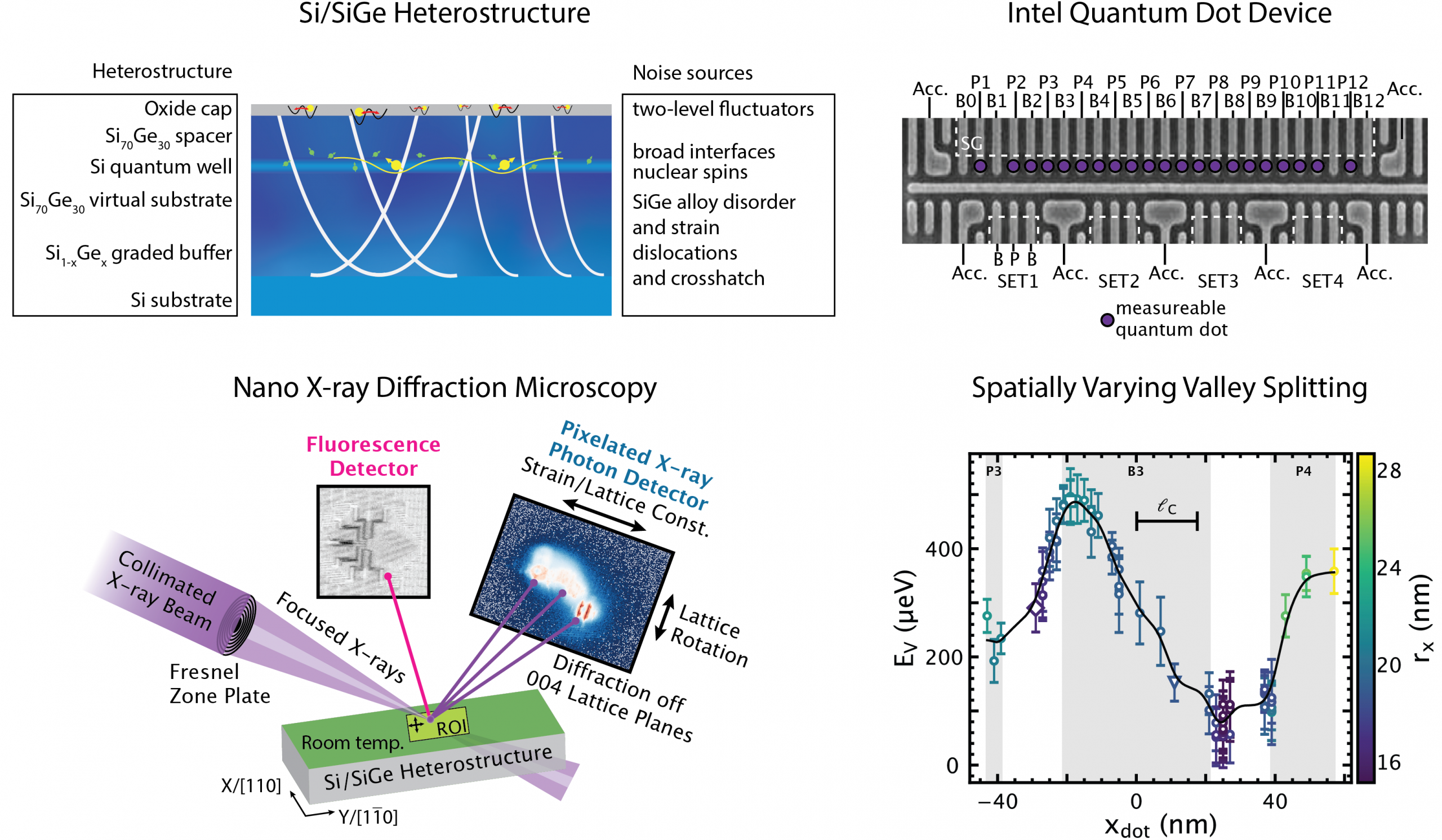
Quantum dot spin qubits in Si/SiGe heterostructures are a promising platform for quantum computing that integrates coherent, localized electron spins with industrial semiconductor manufacturing. However, these single electron qubits are very sensitive to material disorder such as strain, alloy disorder, charge traps, and nuclear spins, which affect the energy landscape and qubit coherence. In particular, the presence of low-lying excited valley energy levels, which arise from the Si quantum well band structure, reduce qubit fidelity, and heterostructure growth necessarily introduces lattice distortions that will affect the homogeneity of scaled-up devices. Through a suite of mK electrical and spin spectroscopy, and nano X-ray diffraction microscopy, we probe these inhomogeneous sources of noise in quantum dot heterostructures, partnering with Intel Corp. and University of Wisconsin-Madison.
Institutions: Argonne National Laboratory, University of Wisconsin-Madison, Intel Corp.
Personnel: Jonathan Marcks, Jack Reily, Emily Joseph, Martin Holt
Recent publications:
J. Marcks, et al. Valley splitting correlations across a silicon quantum well containing germanium, Nature Communications 16 (2025)
J. Marcks, et al. Depth-resolved lattice distortions in a silicon-germanium qubit host, arXiv:2607.26962 (2026)
Telecom spin qubits for quantum networks
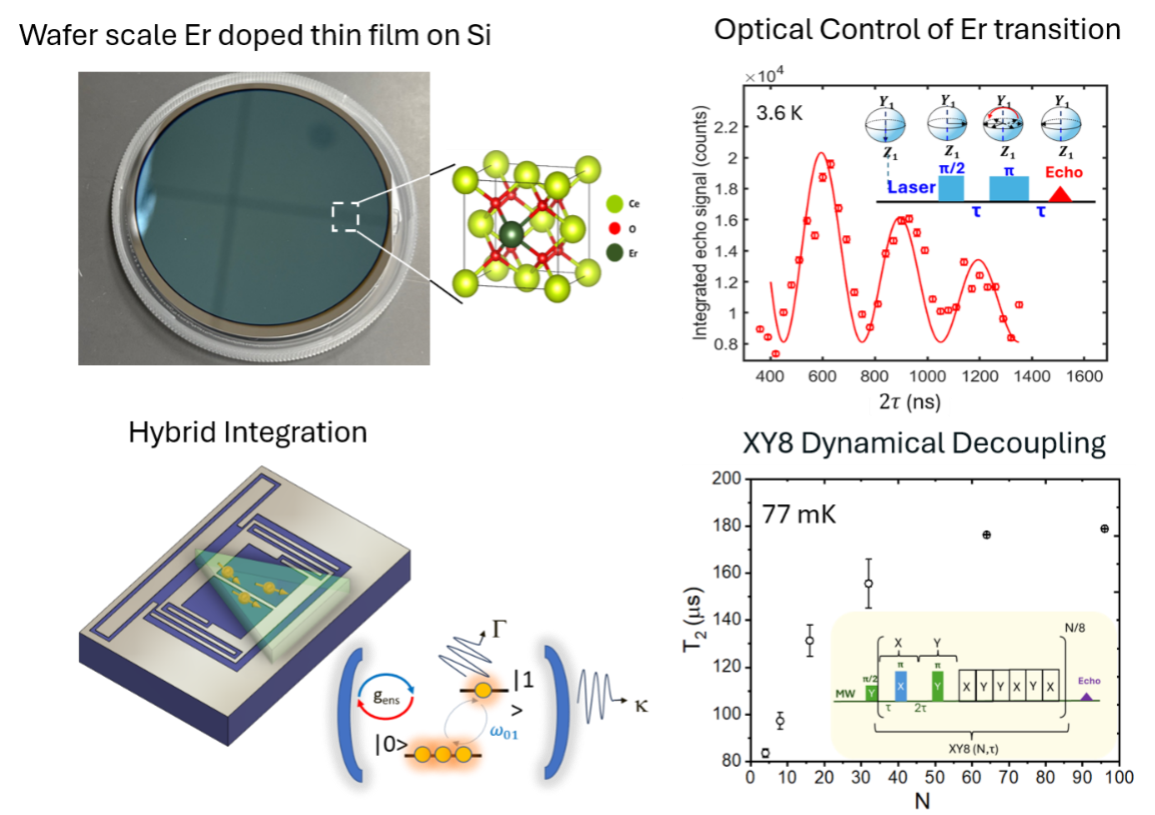
Erbium spin qubits in semiconductors are of great interest for developing quantum memories and repeaters in quantum communication networks as they provide the needed telecom spin-photon interface compatible with long-distance optical fiber networks. One major challenge is to have these spin qubits in a scalable device with their quantum properties over millisecond timescales. We focus on silicon CMOS compatible rare-earth oxide thin films as hosts for Er spin qubits. The optical and spin coherence are sensitive to the local spin-host environment, presence of surfaces/interface and imperfections in hosts. Through materials engineering, one can tailor the specific properties of the qubit, i.e. spin relaxation, decoherence, and strain susceptibility. We combine fundamental materials synthesis and spin physics, leveraging crystal symmetry, new materials, spin bath dimensionalities and unique characterization techniques, towards scalable Er based devices.
Institutions: Argonne National Laboratory, University of Chicago
Personnel: Jiefei Zhang, F. Joseph Heremans, Giulia Galli, Supratik Guha, David Awschalom
Recent publications:
G. D. Grant, et al. Optical and microstructural characterization of Er3+ doped epitaxial cerium oxide on silicon, APL Materials 12, 021121 (2024)
J. Zhang, et al. Optical and spin coherence of Er3+ in epitaxial CeO2 on silicon, npj Quantum Information 10, 119 (2024)
S. Seth, et al. Spin decoherence dynamics of Er3+ in CeO2 films, Physics Review Letters 135, 266901 (2025)