 Non-Gaussian generalized two-mode squeezing: applications to two-ensemble spin squeezing and beyond
Physical Review Letters (2025)
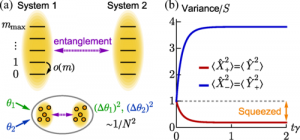
Scientists describe how to generalize a well-known type of quantum state — a two-mode squeezed state — to a wider range of quantum systems.
These states are useful because they are highly entangled, meaning they share a special connection that can be used for better measurements and improved quantum information processing.
They found:
1. Better measurements – The generalized states allow scientists to measure two different properties at once with extreme precision, reaching what’s known as the Heisenberg limit (the best possible accuracy allowed by quantum mechanics).
2. Easy to create – These states can be stabilized using a simple dissipative environment. While dissipation caused by the system environment usually weakens or destroys quantum entanglement, here it is instead harnessed to create it.
3. Works with atomic systems – If these states are used in systems made of particles such as trapped atoms, their usefulness can extend beyond the usual settings, allowing for better quantum sensors and more precise measurements.
The team’s research could help improve how we measure time, magnetic fields or tiny physical forces in quantum experiments, and the method they propose can be tested with today’s technology.
The paper’s authors are Mikhail Mamaev, Martin Koppenhöfer, Andrew Pocklington and Aashish Clerk, conducting work at the University of Chicago and the Fraunhofer Institute for Applied Solid State Physics.