 Entanglement and replica symmetry breaking in a driven-dissipative quantum spin glass
Physical Review X (2024)
In this paper, scientists offer insight into the behavior of quantum spin glass.
Spin glasses are materials with randomly oriented magnetic spins, and spin glass replicas are independent copies of the same spin glass. These replicas can behave in drastically different and seemingly random ways. Yet together, they reveal an underlying order.
The research team demonstrates that a certain type of system — multimode cavity quantum electrodynamics — is a versatile platform to realize and study a quantum spin glass.
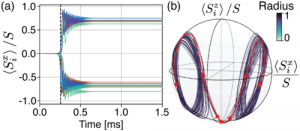
The team bridges the gap between experiment and theory by recognizing that individual experimental trials are exactly the replicas considered in spin-glass theory. The researchers also observe that entanglement plays an important role in the emergence of replica symmetry breaking in specific spin configurations.
Establishing this experiment-theory connection in open quantum systems opens the door to investigating order in a variety of glassy quantum systems. Multimode cavity QED is primed for near-term investigations into the nature of quantum spin glass.
The paper authors are Brendan Marsh, Ronen Kroeze, Surya Ganguli, Sarang Gopalakrishnan, Jonathan Keeling and Benjamin Lev, who conducted their work at Stanford University, Princeton University and the University of St. Andrews.