
Perturbative sensing of nanoscale quantum materials with millimeter-wave photonic crystals
Physical Review Applied (2026)
Scientists have created a silicon chip that can detect the electrical behavior of very small materials by using very high-frequency waves. The chip is patterned so that it traps the waves in a small area, almost like how sound can echo inside a room. When a sample is placed at just the right spot, the trapped wave changes a little. By measuring that change, the researchers can learn about how easily electricity moves through the sample. As a first test, they placed a thin graphene-based sample on the chip and showed that the device could detect its response.
A big reason why this matters is that the chip is made only from silicon and other non-superconducting materials. Many of today’s most sensitive microwave tools for quantum experiments rely on superconductors, which work very well at very low temperatures but tend to fail in strong magnetic fields. That’s a problem because many important quantum materials only reveal their most interesting behavior when they are both very cold and inside large magnetic fields. The team showed that the new silicon design still performs very well when cooled from room temperature down to about 4 Kelvin.
Many materials that are being explored for quantum computing and quantum electronics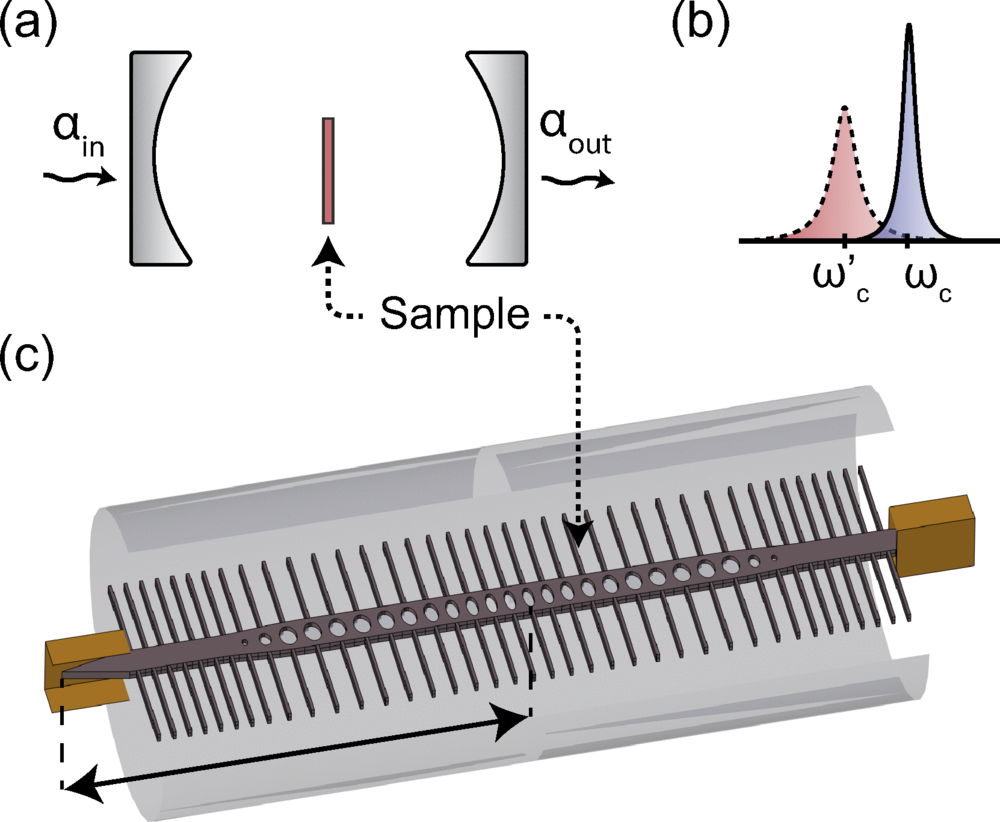 have unusual electrical behavior that is hard to study when the samples are very small or when strong magnetic fields are needed. A chip-scale sensor like the one studied here could help scientists test those materials more easily, especially in extreme low-temperature environments.
The paper authors are Kevin Multani (Stanford University and SLAC), Zhurun Ji (Stanford University and SLAC), Wentao Jiang (Stanford University), Siyuan Qiu (Stanford University), Akasha G. Hayden (Stanford University), Gitanjali Multani (Stanford University), Sharon R. Platt (Stanford University), Emilio A. Nanni (SLAC), Zhi-Xun Shen (Stanford University), and Amir H. Safavi-Naeini (Stanford University and SLAC).