Efficient and compact quantum network node based on a parabolic mirror on an optical chip
PRX Quantum (2026)
Future quantum networks will need networking nodes that can reliably create and share quantum information between distant locations. One way to do this is to entangle an atom with a photon and send the photon through an optical fiber to another node. To make this practical, the system must collect as many photons as possible while preserving their quantum information.
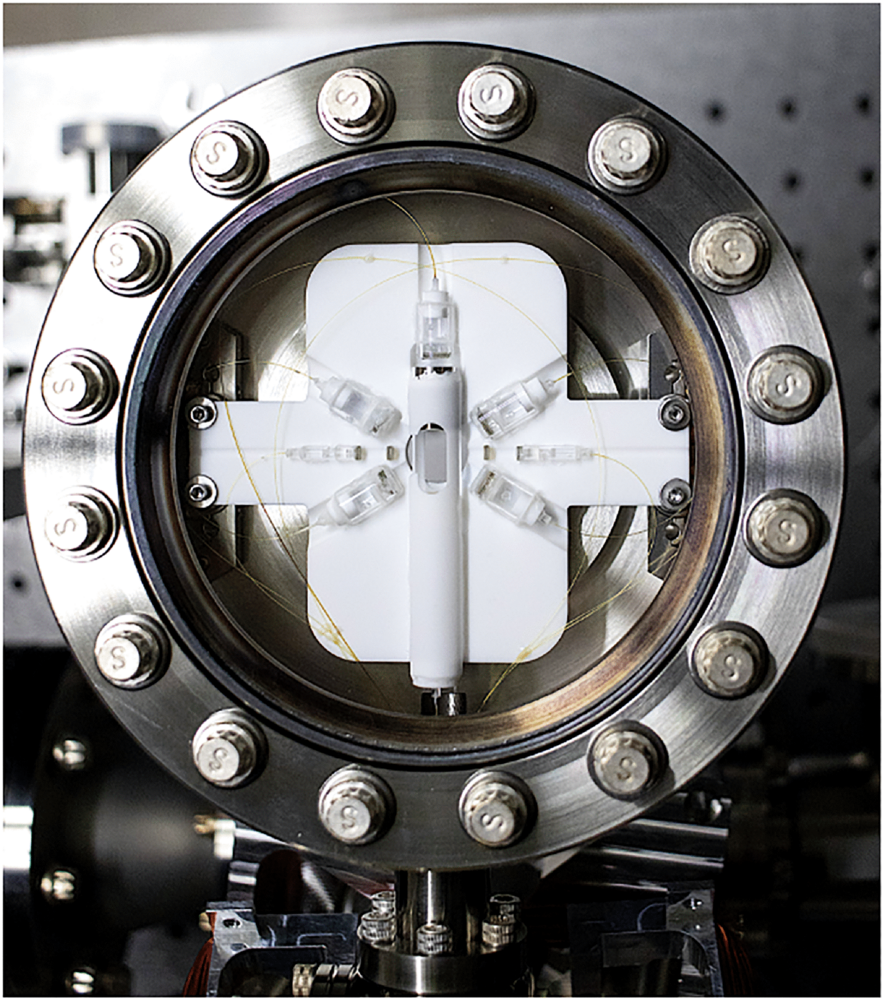
In this paper, researchers built a compact quantum networking node based on a single rubidium atom. A small parabolic mirror both traps the atom and efficiently collects the photons it emits, directing them into an optical fiber. The entire device is assembled from tiny, prealigned optical components, making it stable, compact and resistant to small misalignments.
The researchers were able to collect photons much more efficiently than many existing neutral-atom systems while maintaining very high-quality atom-photon entanglement. They also built the same device twice and achieved similar performance in both systems, showing that the design is reproducible.
Because the platform is fiber-connected and does not require a complicated optical cavity, it could serve as a practical building block for large-scale quantum networks, including quantum repeaters that extend communication over long distances.
The paper authors are Akbar Safari, Eunji Oh, Preston Huft, Gavin Chase, Jin Zhang and Mark Saffman, who conducted this research at the University of Wisconsin–Madison.