
Lightweight machine learning for improved qubit readout

Efficient measurement of neutral-atom qubits with matched filters

Physical Review Applied (2026)


Quantum computers need to accurately measure the state of many qubits at once. In neutral-atom quantum computers, where qubits are packed closely together, light from one atom can interfere with measurements of nearby atoms, creating errors known as readout crosstalk.

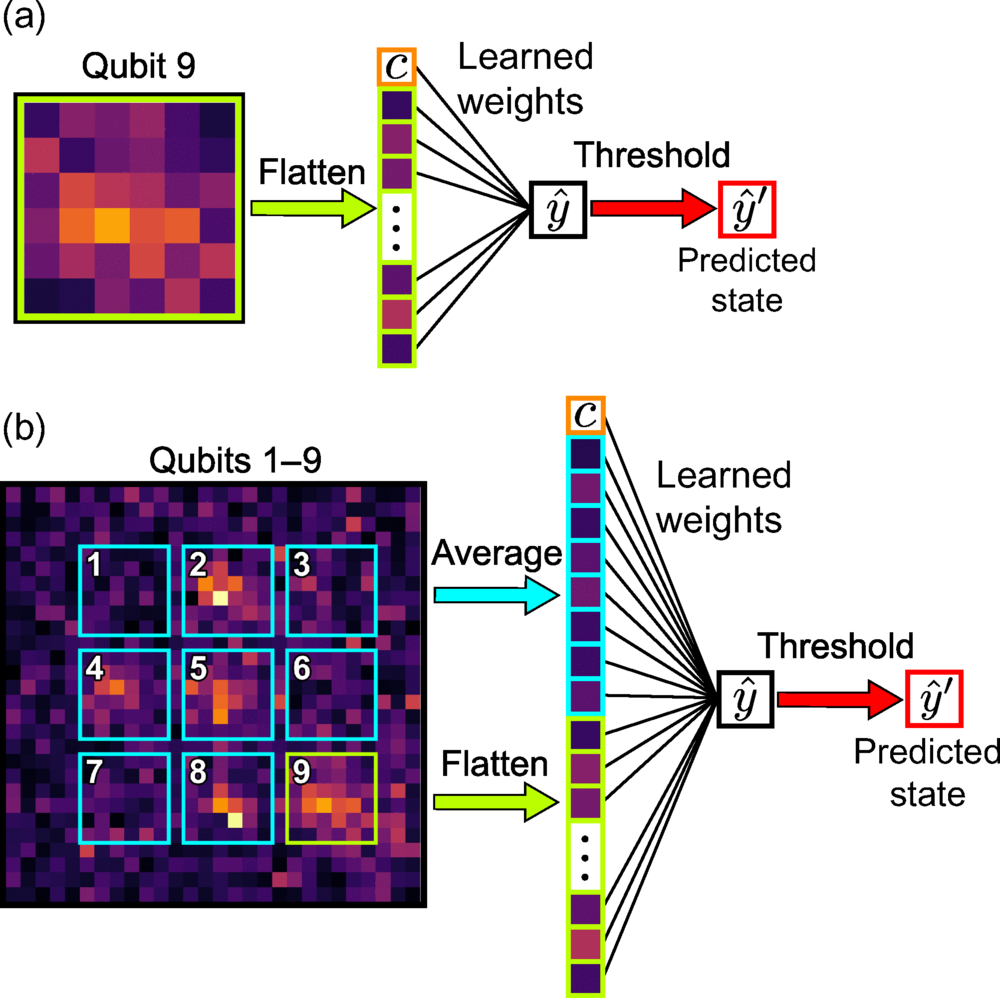
Researchers have previously used complex artificial intelligence methods to reduce these errors, but those approaches require a lot of computing power and become difficult to scale as the number of qubits grows. In this paper, researchers developed two simpler machine-learning methods that can identify qubit states more accurately while using far fewer computational resources. One method analyzes each qubit individually, while the other also considers information from neighboring qubits to correct for crosstalk.

The new approaches reduced measurement errors by up to 43%, ran hundreds of times faster than previous AI methods, and required dramatically fewer parameters and calculations. Because the models are simpler, researchers can also inspect them to better understand the sources of experimental errors. The results suggest that efficient, interpretable machine-learning tools can help enable reliable measurements in larger quantum computers.

The paper authors are Robert Kent, Linipun Phuttitarn, Chaithanya Naik Mude, Swamit Tannu, Mark Saffman, Gregory Lafyatis and Daniel Gauthier, who conducted their work at Ohio State University and the University of Wisconsin–Madison, Infleqtion and ResCon Technologies.

Image is taken from Fig. 1 of ref. DOI:10.1103/x3h2-nz8y with permission of the authors.

News and features

See all news and features
  • David Awschalom wins global Breakthrough of the Year award

    David Awschalom, Q-NEXT Chief Science Officer and the Liew Family Professor of Quantum Engineering and Physics at the University of Chicago, received the prestigious Falling Walls Science Breakthrough of the Year in Physical Sciences for a pioneering body of work that broke the wall between quantum technology, molecules, and proteins. Read More

  • Helium lifts new quantum computing concept

    A team led by Jacob Covey, who is part of Q-NEXT and is an Associate Professor at the University of Chicago, laid out a new concept that could turn helium’s light weight into the next generation of quantum computers. The design relies on helium-3, an isotope with different quantum properties than the helium-4 used to cool MRI machines and fill party balloons. Once built, the computer could use high-powered lasers as “optical tweezers” to capture and control individual atoms of helium. Read More

  • Researchers make materials that support quantum technology

    Researchers from the University of Illinois Urbana-Champaign who are part of Q-NEXT are engineering material systems that support quantum technology. Chris Anderson and his team are developing materials for quantum transduction — the conversion of quantum information from one form to another. Elizabeth Goldschmidt, Daniel Shoemaker, and colleagues are developing quantum memory technology that stores quantum information for extended periods of time. Read More

  • Q-NEXT-developed open-source software receives 2026 R&D 100 award

    SeQUeNCe, a free, open-source software developed by Argonne scientists with Q-NEXT support, is one of seven Argonne projects that received a 2026 R&D 100 Award. The SeQUeNCe software lets researchers test how quantum networks might work before building them. Read More

  • Researchers generate spontaneous magnons that synchronize with external signals

    Researchers at Argonne and the University of Illinois Urbana-Champaign demonstrate a method for generating stable ripples in magnetic materials called magnons. The work opens avenues for information processing in microelectronics and quantum devices. Read More