Capacities of entanglement distribution from a central source
IEEE Transactions on Information Theory (2026)
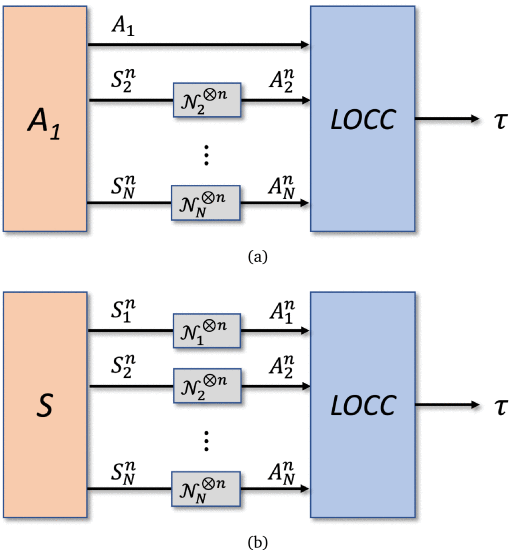
In a future quantum network, a central source may create a shared quantum state and send one part of it to each of several users through noisy communication channels. Because noise can damage the quantum connections, the users must work together using local operations and classical communication to recover useful entanglement.
This study introduces two measures of how well a quantum channel can distribute entanglement: one for pairs of users sharing EPR states and another for multiple users sharing GHZ states. The researchers develop mathematical limits and practical protocols that determine how much entanglement can be reliably distributed through different kinds of noisy channels. For some important channel types, they obtain exact formulas for the maximum achievable distribution rates, helping clarify the fundamental capabilities of quantum communication networks.
The paper is by Xinan Chen, Stefano Chessa, Ian George, Felix Leditzky and Eric Chitambar, who conducted their work at the University of Illinois Urbana-Champaign.