Quantum nanophotonic interface for tin-vacancy centers in thin-film diamond
Physics Review Applied (2026)
A defect in diamond called the tin-vacancy center is a promising type of quantum bit because it can be controlled with light and keeps its quantum properties for a relatively long time, even at temperatures around 1.7 kelvin. But to build practical quantum network devices, researchers need ways to make these defects emit light efficiently and collect that light reliably.
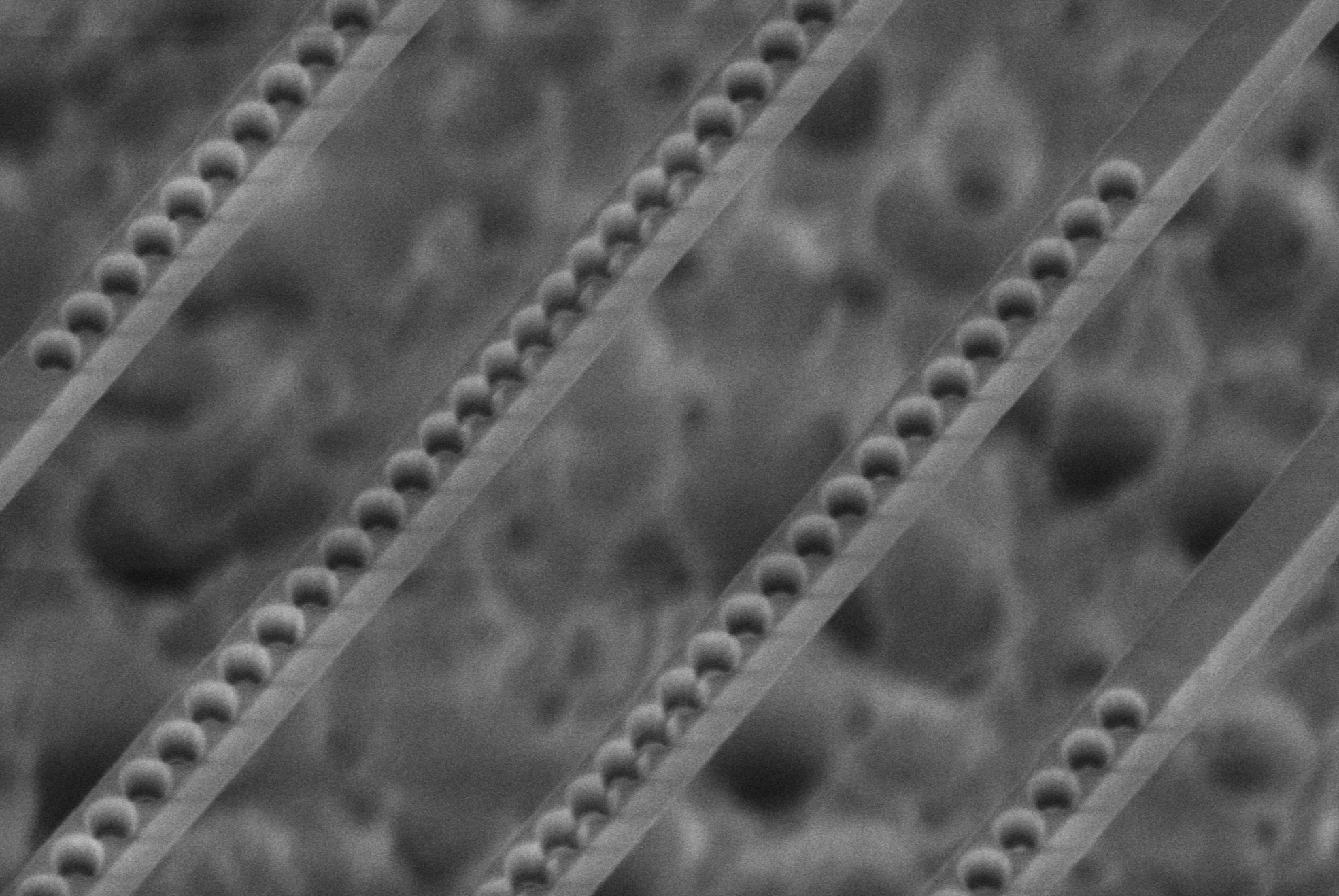
In this paper, researchers built tiny light-trapping structures called photonic crystal cavities into thin diamond films containing tin-vacancy centers. These cavities strongly enhance how the defects emit photons. The team carefully analyzed two different optical transitions of the defect and measured how much the cavity boosts emission. They achieved up to a 26-times-faster spontaneous emission rate and confirmed important details about how the defect emits light. This demonstrates an effective light–matter interface for future diamond-based quantum technologies.
The paper’s authors are Hope Lee, Hannah C. Kleidermacher, Abigail J. M. Stein, Hyunseok Oh, Lillian B. Hughes Wyatt, Casey K. Kim, Luca Basso, Andrew M. Mounce, Shei S. Su, Michael Titze, Ania C. Bleszynski Jayich and Jelena Vuckovic, who conducted the work at the Edward L. Gintzon Lab at Stanford, the University of California, Santa Barbara Department of Physics, UCSB Materials Department, Sandia National Laboratories, Los Alamos National Laboratory and the Luxembourg Institute of Science and Technology Advanced Instrumentation for Nano-Analytics.