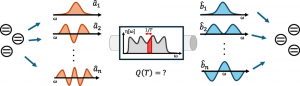
 Quantum communication over bandwidth-and-time-limited channels
Physical Review A (2026)
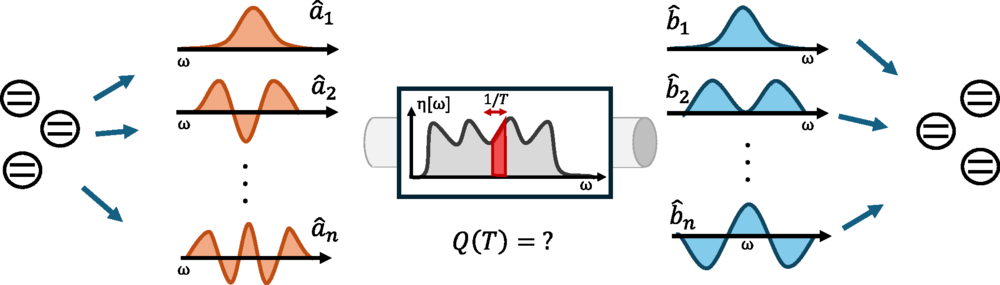
In regular communication systems, you can send more information by using many different frequencies at once (called multiplexing). But in quantum communication, signals don’t last very long because they lose their quantum properties over time, which makes this approach harder to use.
In this paper, the authors look at how much information can realistically be sent when both time and bandwidth are limited. The researchers find the best ways to encode and decode signals under these constraints. They discover that as you make the signal last longer, more communication channels can be used one after another, and that there is an optimal signal length when only a limited number of channels are available.
Their work shows how to best send quantum information when real-world limits on time and frequency come into play.
The paper authors are Aditya Gandotra, Zhaoyou Wang, Aashish Clerk and Liang Jiang, who conducted their work at the University of Chicago.