Correlated dephasing in a piezoelectrically transduced silicon phononic waveguide
Physical Review Applied (2026)
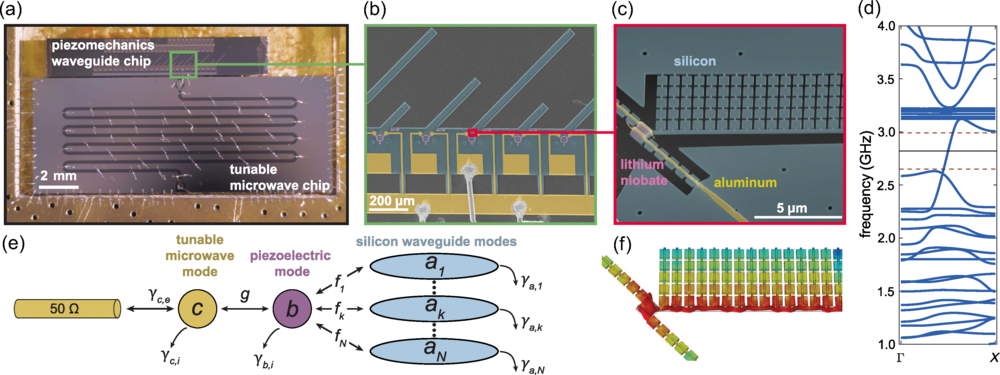
As detailed in this paper, researchers have built and tested a tiny device that guides sound waves (vibrations called phonons) through silicon. The device uses a thin layer of lithium niobate — a material that converts electrical signals into mechanical motion — to turn microwave signals into vibrations and send them along a silicon waveguide. This creates a way to link mechanical vibrations with superconducting quantum circuits.
The team studied the device at extremely low temperatures and measured how strongly the electrical and mechanical parts interact. They also examined how long the vibrations last and how stable their frequency is. While the vibrations can persist for hundreds of microseconds, they found that noise causes the frequency to fluctuate over time. By analyzing these noise patterns, the team gained insight into what limits performance and how to reduce these effects in future quantum acoustic technologies.
The paper authors are Oliver Hitchcock, Felix Mayor, Wentao Jiang, Matthew Peter Maksymowych, Sultan Malik and Amir Safavi-Naeini, who conducted their research at Stanford University.