 Optical readout of coherent nuclear spins in diamond coupled to electronic spins in a thermal state
Phys. Rev. Applied (2025)
Tiny nuclear spins linked to defects in diamond, called nitrogen-vacancy centers, can store quantum information and act as sensors — including tiny gyroscopes that detect rotation. The performance of these nuclear-spin sensors is limited by how long the associated electron spin stays stable. Researchers are working to isolate the nuclear spins so they can last longer, but doing so makes them harder to read out once the electron spins lose their alignment.
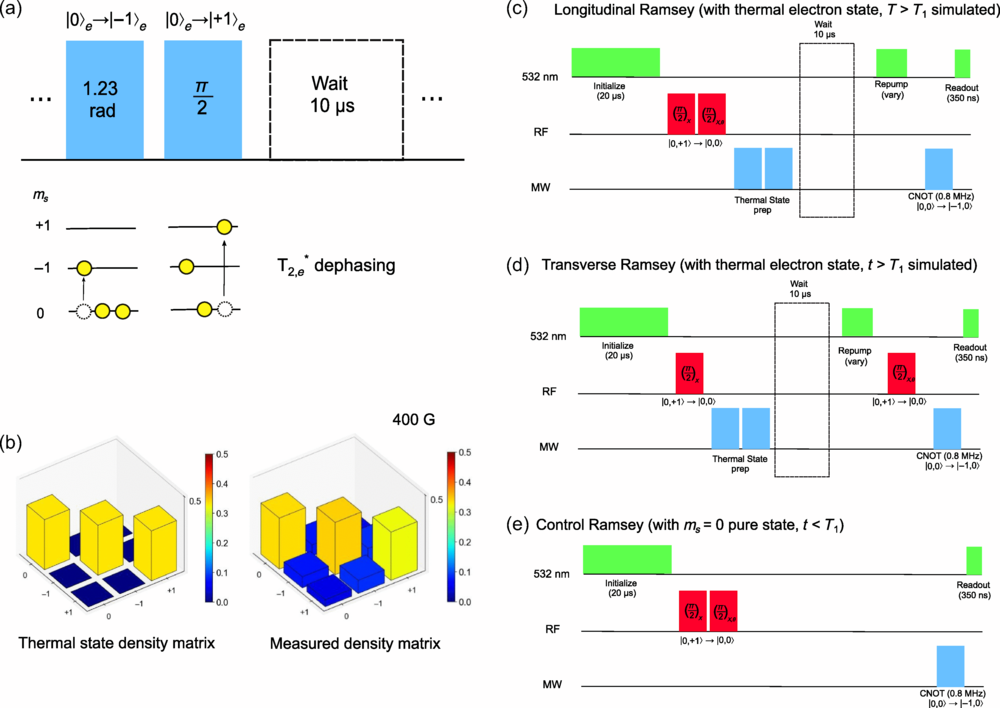
In a new paper, researchers solve that problem by using a burst of laser light to ‘reset’ the electron spins, making it possible to read out the nuclear spins again. They show that this method greatly improves sensor sensitivity, by about six times, under specific magnetic field conditions. The results show how this effect can be used to build better quantum gyroscopes and other precision sensors that rely on nuclear quantum memories.
The research was conducted by Jonathan Kuan and Greg Fuchs, who conducted their work at Cornell University.