 Entropic and operational characterizations of dynamic quantum resources
IEEE Transactions on Information Theory (2025)
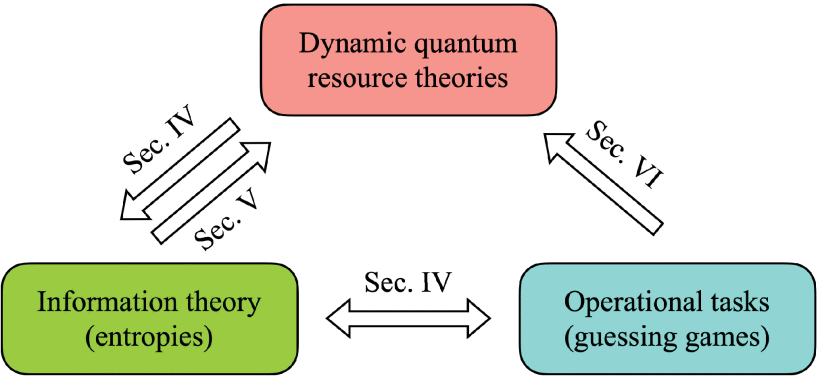
In this paper, scientists explore new ways to describe and analyze different kinds of quantum resources — special features of quantum systems that make them useful for tasks such as computing or communication. The authors use ideas from entropy (a measure of uncertainty or information) and operational tasks (things you can do with the system) to build these methods.
They introduce a new quantity called the free conditional min-entropy, which measures how uncertain an observer is about a quantum system when they’re allowed to use only limited, “free” operations. Using this, they provide a complete set of conditions for when one quantum state or process can be transformed into another within a given resource theory. They also reinterpret an existing measure, robustness, in terms of information, showing how it reflects the advantage a resource gives in communication tasks.
Finally, they show how to test and compare dynamic resources (like quantum channels) using meaningful tasks, creating reliable measures that tell whether one channel can be converted into another. In simple terms, they connect deep mathematical concepts with practical tasks to better understand how quantum resources can be used and compared.
The paper’s authors are Kaiyuan Ji and Eric Chitambar, who did this work at Cornell University and the University of Illinois Urbana-Champaign.